If you’ve ever hired an SEO agency, the pattern is probably familiar.
The engagement starts with optimism.
You receive technical audits, keyword strategies, content calendars, and monthly performance reports. Traffic begins to trend upward, and everything appears to be moving in the right direction.
But a few months later, a more pressing question emerges:
Why is organic traffic growing while qualified leads remain flat?
This is the moment when many founders and marketing leaders begin to question the effectiveness of SEO.
In most cases, the issue isn’t that SEO has stopped working.
It’s that the agency has been optimising for activity rather than business outcomes.
And in 2026, that disconnect is becoming increasingly costly.
With AI overviews reshaping search behaviour and Google placing greater emphasis on expertise, trust, and user intent (EEAT), SEO strategies built on outdated tactics are losing their ability to generate predictable growth.
The Real Problem: SEO Agencies Often Sell Deliverables, Not Growth Systems
Most agencies are built around a familiar retainer model.
Each month, they deliver:
- A set number of blog posts
- Technical recommendations
- Link-building activities
- Ranking reports
The problem?
These deliverables are not inherently tied to revenue.
Growth leaders don’t buy SEO because they want more pages indexed.
They invest because they want:
- Predictable pipeline
- Lower acquisition costs
- Higher search visibility
- Sustainable competitive advantage
When SEO is disconnected from your broader growth marketing strategy, results become inconsistent.
Why SEO Agencies Fail to Deliver Predictable Growth
1. They Chase Rankings Instead of Revenue
Many agencies still celebrate:
- Ranking improvements
- Organic sessions
- Domain authority growth
These are useful indicators, but they are not the end goal.
If those rankings don’t attract buyers with intent, they create noise-not pipeline.
Research and industry commentary consistently point to the same issue: businesses become frustrated when agencies focus on vanity metrics rather than leads and revenue.
2. They Use Templated Strategies Across Every Client
Many agencies run standardized playbooks.
The same process is applied to:
- SaaS companies
- Local businesses
- E-commerce brands
- B2B service firms
But seo services for startups require a very different approach than enterprise SEO.
Startups need:
- Faster experimentation
- Bottom-of-funnel targeting
- Lean budgets
- Agile execution
Generic frameworks rarely fit these realities.
3. They Ignore Conversion Intent
SEO should attract prospects who are actively evaluating solutions.
Yet many agencies prioritize high-volume informational keywords that drive traffic but not qualified leads.
For example:
Ranking for “what is SEO” may generate visits.
Ranking for “best SEO outsourcing services for SaaS startups” attracts buyers.
That distinction matters.
4. SEO Is Treated as a Silo
SEO performance depends on more than keywords.
It is influenced by:
- Website messaging
- UX and CRO
- Brand positioning
- Technical infrastructure
- Sales alignment
When agencies operate independently from these functions, performance plateaus.
That’s why many founders choose to hire marketing experts who can connect SEO with content, design, conversion optimization, and performance strategy.
5. Reporting Explains What Happened, Not What to Do Next
Founders don’t need 20-page reports.
They need answers.
- What’s driving pipeline?
- What’s underperforming?
- What should we prioritize next?
Without strategic interpretation, reporting becomes an administrative exercise rather than a decision-making tool.
6. Slow Response Times Hurt Momentum
Traditional agencies often operate on monthly cycles.
But Google and your competitors move continuously.
If rankings drop early in the month, waiting until the next reporting call can mean weeks of lost opportunity. This “lag problem” is increasingly cited as a reason companies switch partners.
7. They Haven’t Adapted to Modern Search
Search now includes:
- AI Overviews
- Conversational search
- Entity-based ranking
- Zero-click results
Google processes thousands of algorithm updates each year, and search visibility increasingly depends on topical authority, trust signals, and content usefulness- not just keywords and backlinks.
Agencies still using 2018 tactics are struggling to keep up.
Real Industry Data: Why Businesses Replace SEO Agencies
According to Backlinko’s SEO Services Report, only 30% of businesses would actively recommend their SEO provider, and 65% have worked with multiple SEO vendors. This suggests that dissatisfaction with SEO services is not an exception- it is the norm.
The issue is rarely SEO itself.
More often, it is a breakdown in strategy, accountability, and execution.
Warning Signs Your SEO Agency Is Not Delivering
Look for these signals:
- Traffic is increasing, but qualified leads are flat
- Strategy feels generic
- Reports focus on rankings instead of revenue
- Content lacks commercial intent
- Communication is reactive rather than proactive
- Recommendations ignore conversion optimization
If you recognise several of these, your SEO investment may be underperforming.
What Predictable SEO Growth Actually Requires
Predictable SEO is built on systems, not isolated tactics.
Step 1: Align SEO Goals With Revenue Targets
Focus on pipeline contribution, not just rankings.
Step 2: Target High-Intent Keywords
Prioritize searches used by decision-makers.
Step 3: Build Conversion-Focused Content
Answer buyer questions and guide them to action.
Step 4: Strengthen Technical Foundations
Ensure indexability, speed, and structured data.
Step 5: Integrate CRO and UX
Traffic only matters if visitors convert.
Step 6: Measure Business Impact
Track leads, opportunities, and influenced revenue.
Step 7: Iterate Continuously
Use performance data to refine priorities.
The Better Alternative: Managed SEO Outsourcing Services
This is where managed models outperform traditional agencies.
With We The Freelancer, businesses get access to:
- Senior SEO strategists
- Technical specialists
- Content experts
- Relationship managers
- Quality assurance
Instead of managing multiple agencies, you work with a coordinated team aligned to business outcomes.
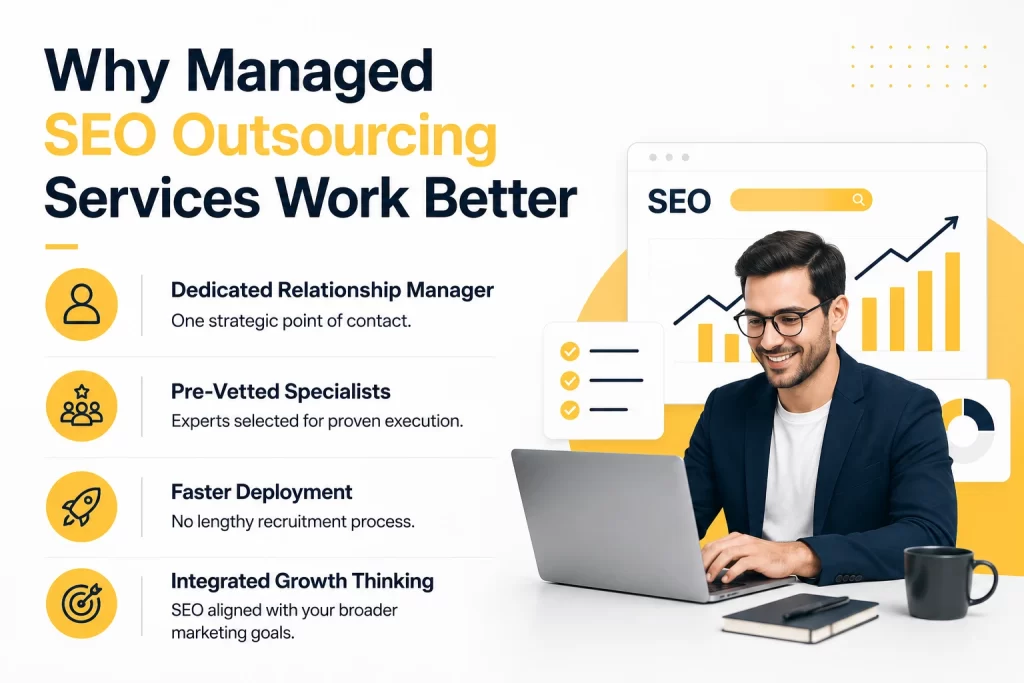
Why Managed SEO Outsourcing Services Work Better
Dedicated Relationship Manager
One strategic point of contact.
Pre-Vetted Specialists
Experts selected for proven execution.
Faster Deployment
No lengthy recruitment process.
Integrated Growth Thinking
SEO aligned with your broader marketing goals.
Traditional SEO Agency vs Managed SEO Partner
| Factor | Traditional SEO Agency | Managed SEO Partner |
| Strategy | Often templated | Customized to business goals |
| Talent Model | Generalist team | Pre-vetted specialists |
| Accountability | Deliverables | Outcomes |
| Communication | Multiple layers | Single relationship manager |
| Scalability | Limited flexibility | Built for growth |
| Integration | SEO-only focus | Cross-functional alignment |
Conclusion: SEO Should Deliver Predictable Growth, Not Just Reports
SEO remains one of the most powerful acquisition channels available to startups and B2B companies.
But only when it is tied to:
- Commercial intent
- Conversion systems
- Strategic accountability
If your current agency is generating activity without business impact, the issue may not be SEO itself.
It may be the delivery model.
The right seo outsourcing services partner combines strategy, execution, and performance oversight to turn organic search into a scalable growth engine.
Ready to Build an SEO Growth Engine That Actually Converts?
If you’re evaluating seo outsourcing services and want a more structured, outcome-focused approach, consider working with We The Freelancer, a managed partner.
Book a Strategy Call to receive:
- A review of your current SEO performance
- Identification of hidden growth opportunities
- A custom roadmap aligned with your business goals
No pressure. Just strategic clarity.
FAQ
Most agencies focus on rankings and deliverables rather than revenue, conversion, and strategic alignment.
They provide specialized SEO expertise and execution without the cost and complexity of building an in-house team.
Yes. Startups need lean, fast-moving strategies focused on high-intent keywords and measurable business outcomes.
It gives you access to specialized talent, structured processes, and faster execution.
Look for strategic alignment, transparent reporting, industry expertise, and accountability tied to business results.