
The Real Problem: Growth Looks Easy—Until It Doesn’t
Most founders and marketing leaders don’t struggle with starting growth.
They struggle with sustaining it.
Month one looks promising. Campaigns go live. Traffic increases. Maybe even conversions tick up.
Then comes the plateau.
- Agency responses slow down
- Quality becomes inconsistent
- Strategy turns reactive instead of proactive
- Costs keep rising—but ROI doesn’t
So the real question becomes:
Why do most growth strategies fail after month three?
The answer often isn’t the channel.
It’s the delivery model.
This is exactly where Managed Professional Services are reshaping how modern businesses approach growth.
What Are Managed Professional Services (And Why They’re Different)?
At a high level, Managed Professional Services combine:
- Strategic oversight
- Execution by vetted freelancers
- Continuous optimization
- Dedicated relationship management
Unlike traditional agencies or fragmented freelance hiring, this model gives you:
✔ A curated team of online marketing experts
✔ A single point of accountability
✔ Built-in quality control and performance tracking
Think of it as:
Agency-level structure + Freelance-level agility + In-house level control
You may also read: Managed Freelance Services vs Traditional Outsourcing
Why Businesses Are Moving Away from Traditional Agencies
1. Lack of Flexibility Slows Growth
Agencies are built for scale—but not always for your scale.
- Fixed retainers
- Rigid scopes
- Slow pivots
When your business needs to move fast, this becomes a bottleneck.
Example:
A SaaS company wants to shift from SEO to performance marketing mid-quarter.
An agency? Contract revision. Timeline delay. Additional cost.
With managed freelance services, you simply reallocate resources.
2. You Don’t Always Get the “A-Team”
Here’s an uncomfortable truth:
The team that sells you the deal is rarely the team that executes it.
Agencies often distribute work across junior staff to maintain margins.
That leads to:
- Inconsistent output
- Generic strategies
- Lack of deep expertise
In contrast, a vetted freelance platform ensures:
✔ You work directly with digital marketing experts
✔ Specialists—not generalists
✔ Performance accountability at an individual level
3. High Costs Without Clear ROI
Many agencies position themselves as a ROI driven marketing agency—but:
- Reporting is often surface-level
- Attribution is unclear
- Optimization cycles are slow
This creates a dangerous gap:
You’re investing more, but learning less.
Modern businesses want:
- Transparent performance tracking
- Faster iteration cycles
- Direct impact on revenue
That’s where outsourced business solutions built on performance accountability outperform legacy models.
4. Communication Gaps Kill Momentum
Growth leaders usually ask:
“Why does it take 3 days to get a simple update?”
Agency communication layers often look like this:
Client → Account Manager → Strategist → Executor
Every layer adds delay and distortion.
With a managed model:
- You get a relationship manager for clarity
- Direct execution happens through internet marketing experts
- Feedback loops are faster and sharper
Managed Professional Services vs Agencies: A Clear Comparison
| Factor | Traditional Agency | Managed Professional Services |
|---|---|---|
| Flexibility | Low | High |
| Talent Access | Mixed (often junior-heavy) | Vetted freelancers only |
| Cost Efficiency | Fixed & high overhead | Scalable & optimized |
| Speed of Execution | Moderate to slow | Fast & agile |
| Accountability | Team-based (diffused) | Individual + managed |
| ROI Visibility | Often unclear | Performance-driven |
| Communication | Layered | Direct + managed |
You may also read: Outsourced Digital Services vs Hiring In-House
The Real Advantage: A Smarter Delivery Model
The shift isn’t just about cost or talent.
It’s about control.
Businesses today want:
- Predictable growth
- Reliable execution
- Scalable teams without hiring overhead
This is why Managed Professional Services are becoming the preferred choice for:
- SaaS companies scaling user acquisition
- E-commerce brands optimizing ROAS
- B2B firms building inbound pipelines
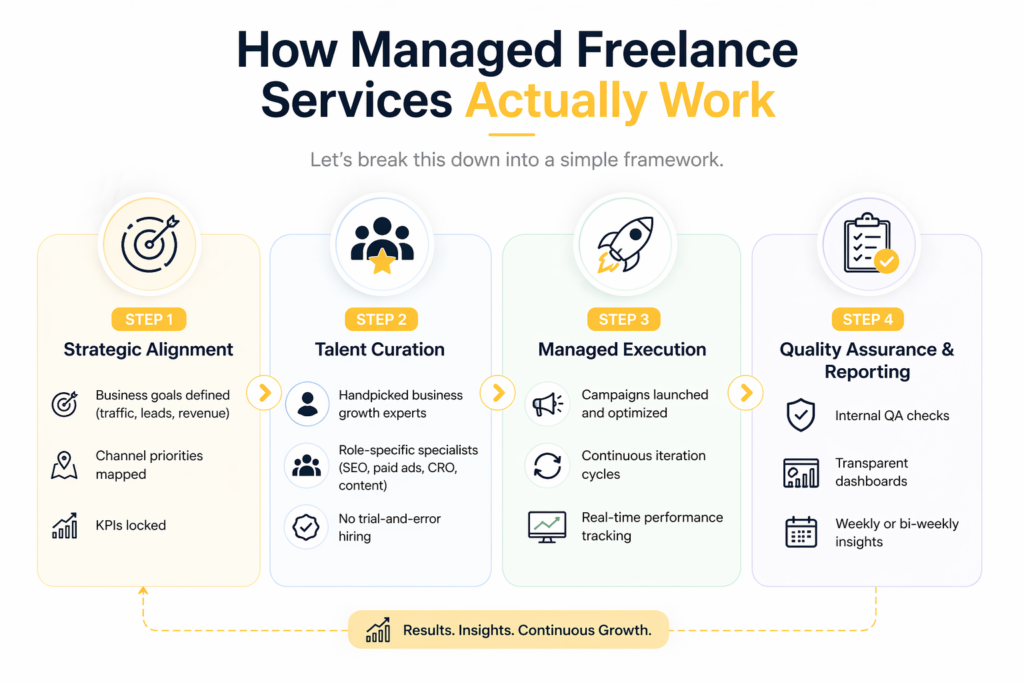
How Managed Freelance Services Actually Work
Let’s break this down into a simple framework.
Step 1: Strategic Alignment
- Business goals defined (traffic, leads, revenue)
- Channel priorities mapped
- KPIs locked
Step 2: Talent Curation
- Handpicked business growth experts
- Role-specific specialists (SEO, paid ads, CRO, content)
- No trial-and-error hiring
Step 3: Managed Execution
- Campaigns launched and optimized
- Continuous iteration cycles
- Real-time performance tracking
Step 4: Quality Assurance & Reporting
- Internal QA checks
- Transparent dashboards
- Weekly or bi-weekly insights
You may also read: Professional Freelance Services Explained: How Managed Models Reduce Risk
Why This Model Works Better for Modern Businesses
You Scale Without Hiring
No need to build an in-house team.
You instantly access:
- freelance digital marketing consulting
- Multi-channel expertise
- Execution-ready specialists
You Reduce Risk
No long-term contracts.
No dependency on a single agency team.
Instead:
- Modular engagement
- Replace or scale talent easily
- Maintain business continuity
You Improve ROI Predictability
Because:
- Specialists drive execution
- Performance is tracked at every layer
- Optimization cycles are faster
You move closer to predictable, repeatable growth.
Where Agencies Still Work (And Where They Don’t)
To be fair—agencies aren’t obsolete.
They still work well when:
- You need branding or large creative campaigns
- You want a one-time strategic push
- Internal oversight is limited
But they struggle when:
- Growth needs constant iteration
- Channels evolve rapidly
- Performance accountability is critical
The WTF Approach: Managed, Not Just Outsourced
At We The Freelancer (WTF), the focus isn’t just on outsourcing.
It’s on ownership and outcomes.
What makes the model different?
- Curated network of vetted freelancers
- Dedicated relationship manager
- Built-in quality assurance systems
- Performance-first execution
Instead of juggling agencies or hiring internally, businesses use WTF as:
A growth and delivery partner, not just a service provider.
Frequently Asked Questions (FAQ)
Managed Professional Services combine strategy, execution, and quality control using vetted experts, all overseen by a centralized management system.
They are often better for performance-driven growth, as they offer more flexibility, faster execution, and better ROI visibility compared to traditional agencies.
Startups scaling quickly
SaaS companies optimizing acquisition
Businesses looking to outsource marketing efficiently
Yes. In fact, marketing services for small businesses benefit the most because they get enterprise-level expertise without full-time hiring costs.
That’s the key advantage of a vetted freelance platform like WTF—talent is pre-screened, performance is monitored, and delivery is managed.
Final Thoughts: The Future of Growth Is Managed
The shift toward Managed Professional Services isn’t a trend.
It’s a response to a deeper need:
- More control
- More transparency
- More predictable growth
Founders and growth leaders are no longer asking:
“Which agency should we hire?”
They’re asking:
“What’s the most efficient way to scale without losing control?”
And increasingly, the answer is clear:
A managed, flexible, performance-driven model powered by experts—not overhead.