
Freelance marketplaces have become the default starting point for modern businesses.
Need quick execution? You can instantly access thousands of digital marketing experts. Want flexibility? You can scale up or down without long-term commitments. Trying to control costs? The pricing often looks significantly lower than that of agencies or in-house hiring.
On paper, it feels like the perfect system.
And in the early stages, it often works. But here’s what founders and growth leaders eventually realise:
What looks efficient at the beginning becomes unpredictable at scale.
The Reality of Freelance Marketplaces (What No One Tells You)
Freelance marketplaces promise three things:
- Speed
- Flexibility
- Lower cost
And in the early stages, they work.
You can quickly hire digital marketing experts, get campaigns running, and start executing without long hiring cycles.
But here’s the problem:
Marketplaces are built for access, not outcomes.
The “Quality Lottery” Problem
Some hires work.
Many don’t.
And the gap between those two outcomes is massive.
A wrong hire doesn’t just cost money – it costs:
- Time
- Momentum
- Opportunity
In fact, bad marketing hires can cost tens of thousands in wasted spend and lost growth cycles
When Freelance Marketplaces Start Breaking Down
Most businesses don’t fail with freelancers immediately.
They fail when they try to scale.
You’ll typically hit friction when:
- Growth plateaus despite consistent execution
- Managing freelancers becomes a full-time job
- Results vary across channels
- No one owns strategy
The 5 Hidden Risks of Freelance Marketplaces
1. Vetting Takes More Time Than You Think
To truly hire pre-vetted freelancers, you need to:
- Review portfolios
- Run interviews
- Assign test projects
- Validate past results
This process can take 10–20 hours per hire.
Now multiply that across:
- SEO
- Paid ads
- Content
- Development
You’re not saving time – you’re shifting it internally.
2. The Real Cost Is Higher Than the Price
Marketplace pricing looks attractive.
But hidden costs include:
- Platform fees
- Freelancer markups
- Revisions and delays
What seems “cheap” often becomes expensive in execution.
3. No Ownership of Results
Freelancers deliver:
- Tasks
- Outputs
But not:
- Business outcomes
- Revenue impact
So when performance drops, there’s no accountability.
4. Fragmented Strategy Across Channels
A typical setup:
- One freelancer for SEO
- Another for ads
- Another for content
Even if they’re strong online marketing experts, they operate independently.
The Result:
- Inconsistent messaging
- Broken funnels
- Poor conversion rates
Growth becomes disconnected instead of compounding.
5. Communication & Execution Gaps
Working with multiple freelancers creates:
- Time zone delays
- Misaligned expectations
- Slow iteration cycles
And in growth, speed is leverage.
Red Flags to Watch Before Hiring
Before committing, look for these signals:
Vague Portfolios
No clear case studies or measurable outcomes
Unrealistic Pricing
Too low usually means:
- Inexperience
- Outsourced work
- Template-based execution
Poor Communication
If clarity is missing early, it worsens later
No Strategic Thinking
Execution without context is a major risk
How to Reduce Risk (If You Stay on Marketplaces)
If you continue using freelance platforms:
- Use milestone-based contracts
- Define KPIs upfront
- Limit system access
- Run paid trial projects
- Document workflows
This improves outcomes, but still requires heavy internal management.
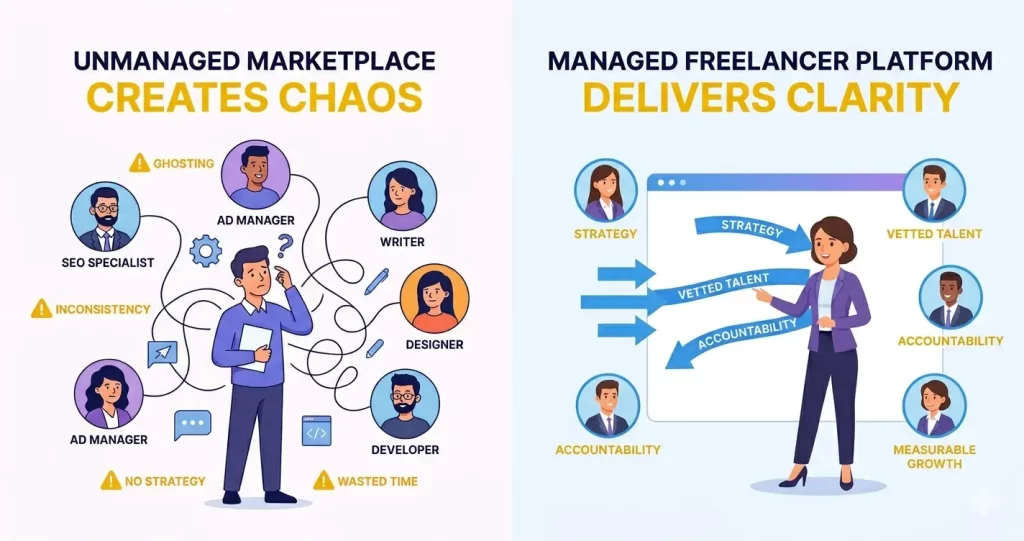
The Better Alternative: A Managed Freelancer Platform
Instead of managing freelancers individually, many businesses are shifting toward a structured model.
This is where We The Freelancer comes in.
What Is a Managed Freelancer Platform?
A managed freelancer platform combines:
- Pre-vetted talent
- Strategic oversight
- Quality assurance
- Centralized execution
Instead of hiring individuals, you get a coordinated system.
Why Businesses Choose an Outsourced Digital Marketing Partner
An outsourced digital marketing partner solves the exact problems marketplaces create.
1. Strategy + Execution Together
No more disconnected work.
You get:
- Aligned campaigns
- Integrated funnels
- Continuous optimization
2. Pre-Vetted, High-Quality Talent
You still work with top digital marketing experts.
But they are vetted for:
- Business understanding
- Execution quality
- Collaboration ability
3. Centralized Communication
Instead of managing multiple freelancers:
You get:
- One relationship manager
- One communication flow
- One growth roadmap
4. Accountability for Results
Unlike marketplaces:
- Performance is tracked
- Outcomes are measured
- Strategy evolves
Marketplace vs Managed Model
| Factor | Freelance Marketplace | Managed Model |
| Hiring Time | Fast | Fast |
| Vetting Responsibility | Yours | Platform |
| Strategy | Fragmented | Integrated |
| Accountability | Low | High |
| Scalability | Difficult | Built-in |
When Should You Move Away from Marketplaces?
You should consider switching when:
- Growth becomes inconsistent
- Managing freelancers slows you down
- Quality varies across deliverables
- You need predictable scaling
At this stage, working with an outsourced digital marketing partner becomes a strategic decision, not just an operational one.
Final Takeaway: Stop Hiring, Start Building Systems
Freelance marketplaces are useful.
But they’re not built for long-term growth.
The Real Shift
From:
Hiring freelancers
To:
Building a scalable marketing system
Because sustainable growth requires:
- Control
- Reliability
- Strategic alignment
Ready to Reduce Risk and Scale Faster?
If you’re evaluating your next growth move:
- Get a custom growth plan
- Explore a managed execution model
- Work with a team that owns outcomes
Start Your Growth Strategy Session
FAQ
An outsourced partner manages strategy, execution, and performance across marketing channels, ensuring business alignment.
It reduces risk but doesn’t guarantee strategy alignment or accountability.
A platform that combines vetted talent with project management and quality control to deliver consistent results.
Consulting provides strategy, while managed services handle both strategy and execution.
When growth becomes inconsistent, management overhead increases, and scaling becomes difficult