Why do most marketing efforts break after the first 90 days?
For most small businesses, growth leaders, and founders, the trajectory is painfully predictable. You hit a growth ceiling, realise your current bandwidth is stretched thin, and decide to scale your marketing. Then, the friction begins.
Hiring an in-house team takes months, demanding overhead costs that drain your runway before you see a single qualified lead. Turning to freelancers often feels like a gamble – you find yourself managing a disjointed web of unvetted copywriters, developers, and ad buyers just to keep a simple campaign on track. Or you sign a rigid retainer with a traditional marketing outsourcing agency, only to realise their overhead is funding their beautiful office, not your growth.
The real issue isn’t strategy – it’s execution consistency. Founders often underestimate the sheer operational drag of managing marketing execution. When you are forced to act as project manager, interpreter, and quality assurance team for your marketing partners, you aren’t scaling your business – you are just taking on a second full-time job.
To break out of this cycle, small businesses need a model that balances control, scalability, and predictable cost. That is where managed marketing services for small businesses come into play.
What Are Managed Marketing Services?
At its core, a managed marketing service is an execution-focused partnership model designed to eliminate the operational friction of growth. Unlike a traditional agency that sells opaque, high-level strategy – or isolated freelancers who require constant oversight – a managed service provides an end-to-end execution layer.
Think of it as plug-and-play marketing infrastructure. You gain access to a curated team of digital marketing experts spanning SEO specialists, performance marketers, content strategists, and analysts – all working under a dedicated relationship manager.
Unlike project-based freelancers (who disappear after delivery) or traditional agencies (who retain strategic control while keeping you at arm’s length), managed marketing services function as an embedded execution partner. You retain strategic ownership. They own delivery accountability.
Why Small Businesses Struggle with Marketing Execution
Growth leaders usually hit this ceiling when they treat marketing as a series of isolated tasks rather than an interconnected ecosystem. When small businesses turn to digital marketing outsourcing services, they often fall into three common execution traps.
The Fragmented Freelance Trap. Hiring a freelance digital marketing consultant might solve your immediate need for a blog post or ad setup. But those channels cannot live in silos. When your freelance copywriter doesn’t talk to your performance marketer, your brand message fractures, your user journey breaks, and your ROAS plummets.
The Management Overhead Tax. When you work with an unmanaged outsource marketing company, the burden of proof falls entirely on you. You spend weekends auditing copy, checking tracking pixels, and chasing deliverables. You haven’t outsourced marketing – you’ve just outsourced the typing.
The Strategic Mismatch. Many businesses turn to an outsource digital marketing company expecting a proactive growth engine, only to receive order-takers. If you have to tell your external team exactly what to do every Tuesday morning, you haven’t built a growth partnership – you’ve built a dependency.
The core execution gaps that push small businesses toward outsourced digital marketing services include talent fragmentation (sacrificing specialist depth for generalist breadth), freelancer inconsistency (variable quality, missed timelines, single points of failure), agency dependency (structured for retainer revenue, not sprint velocity), and no execution rhythm (reactive output instead of compounding growth).
You may also read: The Hidden Risks of Freelance Marketplaces and How to Avoid Them
Managed Services vs. Outsourcing vs. Traditional Agencies
Choosing the right partner requires understanding how different model frameworks impact your operational control, cost efficiency, and scalability.
| Dimension | Traditional Agency | Freelancer / Outsourcing | Managed Marketing Services |
| Operational Control | Low – execution in a black box | High – but requires heavy daily management | Balanced: clear visibility without the management drag |
| Scalability & Agility | Low – bound by rigid SOWs and long contracts | Variable – dependent on individual availability | High – scale resources up or down based on data |
| Cost Efficiency | Low – high retainers cover agency overhead | High hourly rate; high management cost | High – pay for direct execution and outcomes |
| Accountability | Tied to vanity metrics (impressions, clicks) | Tied to task completion, not business growth | Tied to business KPIs: CAC, pipeline, revenue |
| Quality Assurance | Dependent on the account manager assigned | Non-existent – you are the editor-in-chief | Built-in – managed layer reviews all deliverables |
| Execution Speed | 2–4 week onboarding | Immediate but inconsistent | Fast deployment with managed handoffs |
| Talent Depth | Senior strategists, junior executors | One skill set per contractor | Multi-specialist pods per engagement |
| Risk Profile | High switching cost | High churn cost | Managed continuity |
The pattern is clear: outsourced digital marketing services solve the cost problem but create an accountability vacuum. Agencies solve accountability but introduce cost and control friction. Managed marketing services are engineered to solve both – simultaneously.
You may also read: Managed Freelance Services vs Traditional Outsourcing: A Strategic Framework for Predictable Growth
How Small Businesses Can Use Managed Marketing Services Effectively
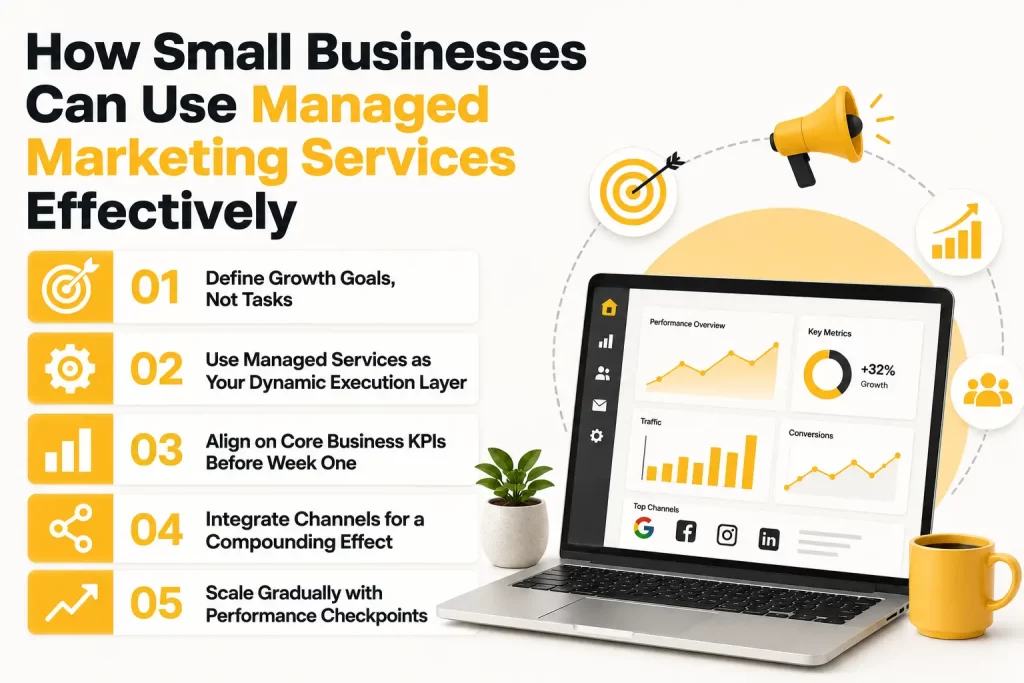
Simply partnering with a managed service provider isn’t a silver bullet. To maximise your investment and drive real pipeline, you must approach the collaboration strategically. Here is the five-step execution framework.
1. Define Growth Goals, Not Tasks
The fastest way to fail with any marketing outsourcing agency is to hand them a laundry list of tasks. “Write four blog posts and post three times on LinkedIn” is a task. “Increase organic demo requests by 30% in Q3” is a goal.
Before onboarding a managed service, document your primary growth metric (pipeline, MQLs, ROAS, ARR), your 90-day target and the channels most likely to move it, and the decision-making authority your managed team will have.
When you present goals instead of tasks, you allow online marketing experts to build the tactical roadmap that actually achieves the objective. Managed execution works best when it’s aligned to outcomes – not activity.
2. Use Managed Services as Your Dynamic Execution Layer
Do not treat your managed service provider as an external vendor – treat them as your scalable marketing department. Your internal team should focus on core business strategy, product-market fit, and deep customer insights. Let the managed service act as the heavy machinery that turns those insights into live campaigns.
Because a managed service provides a cross-functional squad, you can pivot tactical execution without changing your contract. If data shows paid acquisition is getting expensive, shift focus toward organic growth without firing an ad buyer and hiring an SEO writer. That flexibility is rare and valuable.
3. Align on Core Business KPIs Before Week One
Step away from vanity metrics. Impressions, likes, and raw traffic numbers look great on monthly slide decks but don’t pay the rent. Before any brief is written, define the metrics your managed team will be held accountable to:
- Customer Acquisition Cost (CAC): Total fully loaded cost to acquire a paying customer through these channels
- Return on Ad Spend (ROAS): Whether paid campaigns are driving clear, trackable profitability
- Pipeline Contribution: How much qualified pipeline value your content and SEO engine generates
- Organic Traffic & Conversion Rate: For content-led growth measurement
If your managed service can’t commit to reporting on these metrics weekly, it’s a red flag. Explore our managed SEO services to see how KPI accountability is structured from day one.
4. Integrate Channels for a Compounding Effect
A common mistake small businesses make with online marketing outsourcing is running disconnected campaigns. True marketing efficiency happens when your channels complement one another. SEO and content generate demand signals. Paid media captures and accelerates intent. Email and nurture sequences convert pipeline.
When selecting a managed marketing provider, evaluate whether they can operate across SEO, paid, and content as an integrated system – or whether they’re building three isolated funnels. The difference between these two approaches is the difference between linear and compounding growth. See how performance marketing teams are structured for integrated execution.
5. Scale Gradually with Performance Checkpoints
Start narrow. One or two channels. One core ICP. One traffic-to-conversion funnel. Run for 60–90 days. Evaluate CAC trends, content velocity, and pipeline quality. Then expand.
The beauty of a managed service is that it mitigates downside risk. You do not need to launch with a massive budget on day one. Begin by stabilising your core channel, achieve a predictable baseline ROI, then scale budget and expand into secondary acquisition channels. Managed marketing services are not set-and-forget – the best engagements are iterative, with quarterly reviews that recalibrate channel mix and budget allocation based on actual data.
Real-World Strategic Scenarios
Scenario A: SaaS Growth Team Scaling Lead Generation
A B2B SaaS platform in its growth phase needed to transition from founder-led sales to a predictable inbound engine – without the time or capital to hire an in-house SEO and content team. By engaging a managed service, they deployed a fully functional organic growth pod within weeks, targeting high-intent commercial keywords across a structured content hub. Running SEO content and LinkedIn paid campaigns in parallel, they scaled from 80 MQLs per month to 310 MQLs within five months – with CAC dropping 28% as organic traffic began compounding.
Scenario B: eCommerce Brand Improving ROAS
A DTC skincare brand generating $400K/month in revenue was running Google Shopping and Meta Ads internally. ROAS had plateaued at 2.1x for two consecutive quarters – not because the strategy was wrong, but because the execution lacked the technical depth to optimise at scale. A managed performance team restructured their campaign architecture, rebuilt audience segmentation, and introduced systematic creative testing cycles. ROAS improved to 3.8x within 90 days, while overall ad waste dropped significantly.
Scenario C: B2B Professional Services Firm Building Pipeline
A 12-person management consultancy relied entirely on referrals and manual outbound networking. They had no digital footprint, no inbound engine, and no formal demand generation function. Using a managed content and SEO model, they built a content asset library targeting mid-funnel search intent, supplemented by an executive thought leadership programme on LinkedIn. Inbound pipeline grew from near-zero to 18 qualified conversations per month within six months – reducing their dependence on inconsistent outbound sales cycles.
When to Use (and NOT Use) Managed Marketing Services
Transparency is key to a successful partnership. This model is powerful – but it is not the right fit for every business scenario.
Choose managed marketing services if:
- You have a proven product-market fit but lack operational bandwidth to execute marketing consistently
- You want to scale output without adding long-term internal headcount and overhead
- You want to maintain strategic control over your brand while having tactical execution handled by experts
- You need access to a diverse, multi-disciplinary team (designers, writers, developers, media buyers) rather than a single specialist
Do NOT choose managed marketing services if:
- You don’t know who your customer is – if you’re still figuring out your basic value proposition, no execution layer can save you; you need foundational business consulting first
- You want a pure black-box arrangement – if you expect magic to happen without any internal strategic alignment, you will be disappointed
- You have an incredibly niche, deeply technical product requiring a full-time in-house subject matter expert in every product meeting
- Your budget is below the threshold for effective managed execution – typically $3K–$5K per month minimum
This distinction matters. The worst-performing engagements happen when founders mistake managed execution for strategic consulting. Know which problem you’re solving. Read our guide on outsourcing digital marketing effectively to understand where managed services fit in your overall growth model.
Why Managed Freelance Services Are Emerging as the Middle Ground
As small businesses look to optimise their budgets, a new tier has emerged that bridges the gap between old-school agencies and chaotic freelance platforms: Managed Freelance Services.
This is where We The Freelancer (WTF) transforms the execution landscape.
WTF provides the ultimate middle ground for scaling businesses – combining the cost-efficiency, agility, and specialised skill sets of top-tier vetted freelancers with the structural security, quality control, and accountability of a premium agency.
When you partner with WTF, you are not posting a job description and hoping for the best. You are assigned a dedicated Relationship Manager who acts as your single point of contact. They understand your growth goals, translate your strategy into execution roadmaps, and assemble the right squad of digital marketing experts and outsource digital marketing specialists from our vetted talent pool.
WTF handles the vetting, payroll, scheduling, and rigorous quality assurance – including reviewing all deliverables against your brand guidelines before anything reaches your desk. You get premium, agency-grade output with predictable, scalable growth – without the agency markup or the freelance administrative nightmare.
Conclusion: Reclaim Control of Your Growth
Scaling your business shouldn’t mean sacrificing your peace of mind or spending your days micromanaging marketing tasks. The traditional trade-off between high agency overhead and operational freelance chaos is no longer the only option.
By adopting managed marketing services for small businesses, you introduce control, predictability, and capital efficiency back into your growth strategy. The businesses winning in their categories right now aren’t outspending competitors – they’re out-executing them, with leaner teams, better systems, and smarter outsourcing decisions.
If your current marketing effort breaks every 90 days, the problem isn’t the strategy. It’s the infrastructure.
Fix the infrastructure. Explore our managed SEO services and custom growth solutions today, and let’s scale your business with precision.
Frequently Asked Questions
Traditional agencies often manage campaigns in a black box, locking you into rigid long-term contracts with high retainers that fund internal overhead. Managed marketing services act as a transparent execution layer plugged directly into your business. You retain strategic control while a cross-functional team of specialists – led by a dedicated relationship manager – handles delivery with built-in quality assurance and KPI accountability.
Engagements typically starting from $99 per month depending on channel scope, specialist depth, and execution volume – considerably lower than full-service agency retainers, which often begin at $1000 and above per month for comparable output. Because managed services scale with your business, pricing is tied directly to execution scope rather than flat, inflated retainers.
Absolutely. Managed services are designed to be highly integrative. Whether you have an internal marketing manager who needs an execution team to scale their strategy, or an existing plan that lacks execution consistency, a managed service provider like WTF can audit your current assets and deploy the right specialists to execute your vision immediately.
The inflection point is usually when internal execution capacity becomes the constraint – not strategy or budget. If your team is missing content deadlines, failing to scale paid campaigns, or managing too many freelancer relationships, it’s time to evaluate a managed model.
The core metrics depend on your growth model but typically include: Customer Acquisition Cost (CAC) by channel, Return on Ad Spend (ROAS) for paid campaigns, organic traffic growth and conversion rate, and pipeline contribution per channel. A competent managed partner will report on these weekly and adjust tactics accordingly.
At We The Freelancer (WTF), every digital marketing specialist in our network goes through a rigorous vetting process assessing technical skills, industry experience, and communication. Your dedicated Relationship Manager also reviews all deliverables against your specific brand guidelines and quality standards before anything reaches your desk – eliminating the risk of unvetted talent entirely.
A managed freelance service places vetted specialist freelancers into structured engagements with quality assurance, relationship management, and performance tracking built in. Unlike hiring freelancers directly – where you absorb all management, vetting, and quality control costs – a managed freelance model like WTF handles the operational layer entirely, combining the cost efficiency of freelance hiring with the accountability and continuity of a managed agency.