You open your Meta Ads Manager on a Tuesday morning. Your ROAS dropped from 4.2 to 3.1 overnight. Your cost per lead went up. You didn’t change anything.
You panic. You start tweaking budgets. You kill ad sets. Nothing works.
Here’s the truth: your ads didn’t break. Meta changed the rules.
2026 has brought the most sweeping Meta Ads changes since the iOS 14 update wrecked everyone’s tracking in 2021. Attribution is different. Targeting is different. Where your ads appear is different. And the AI engine running it all – a system called Andromeda – is something most advertisers have never even heard of.
This blog is going to fix that.
At We The Freelancer (WTF), our Facebook Ads management and paid social specialists work across 38 countries. Whether you’re spending $500/month on Facebook Ads for your cleaning business or $50,000/month for your e-commerce brand – these updates affect you. Let’s break it all down in plain English.
First, Meet Andromeda – The AI Engine Running Your Meta Ads
Before we get into specific updates, you need to understand one thing: Meta is no longer just a platform you advertise on. It’s an AI system you feed inputs to.
That system is called Andromeda. Rolled out gradually from late 2024 and fully deployed across most objectives and placements by October 2025, it’s now the engine behind how ads are selected and shown across Facebook, Instagram, Reels, and Threads.
Here’s what makes Andromeda fundamentally different from the old Meta system:
Before Andromeda: You chose your audience. You picked interests, behaviors, age ranges, locations. Meta showed your ad to those people.
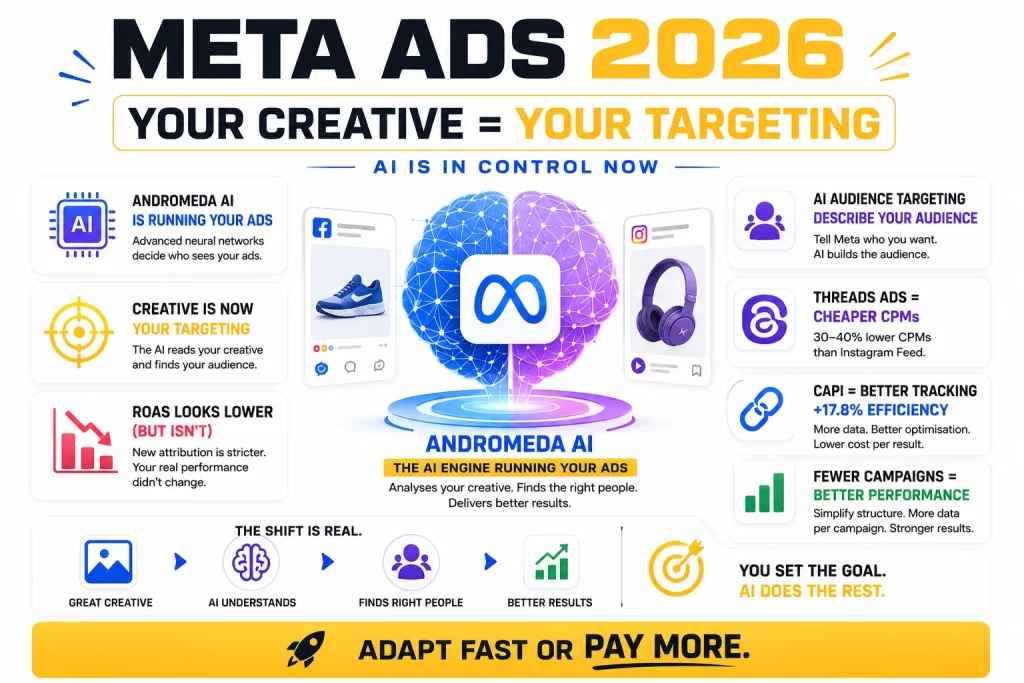
With Andromeda: Meta’s deep neural network analyses your ad creative – the image, the video, the headline, the copy – and uses that to determine who should see it. The AI reads the meaning of your content, not just the targeting parameters you set.
One important note: Andromeda doesn’t work alone. It operates alongside two other systems – Meta Lattice, which handles the auction ranking stage, and GEM (Generative Engagement Model), which powers Meta’s AI creative tools. Together, they’ve completely rebuilt the pipeline from ad retrieval to delivery. But Andromeda is the layer that matters most for how your targeting actually works.
Think about what this means for a plumbing company in Houston. Before, you’d target homeowners aged 30–65 interested in home improvement. Now, if your ad shows a flooded bathroom with the headline “Burst pipe at 2am? We’re there in 60 minutes” – Andromeda reads that signal and finds the people in Houston most likely to need emergency plumbing, even if they never clicked “interested in plumbing” on Facebook.
The bottom line: Your creative is now your targeting. This is the single most important concept shift in Meta Ads in 2026.
1. Attribution Just Got Honest – And Your Numbers Will Look Worse (Even Though They’re Not)
This is the update causing the most confusion and panic right now – so let’s clear it up fast.
Meta officially changed how click-through attribution works in March 2026.
Previously, if someone liked your ad, saved it, or shared it – and then bought something later – that counted as a click-through conversion. Meta was crediting itself for sales it probably shouldn’t have been.
Now, only actual link clicks count as click-through conversions. Likes, saves, shares, and comments are now tracked under a new category called “Engage-through attribution” (which replaced the old “engaged-view” model). Meta also shortened the video engaged-view threshold from 10 seconds to 5 seconds – reflecting that 46% of Reels purchase conversions now happen within the first 2 seconds of attention.
The result: Your ROAS number in Ads Manager is going to drop – even if your actual sales stay exactly the same.
Real-world example: A handmade candle brand was reporting a ROAS of 4.8x in Meta Ads Manager. After the attribution change, that same performance now reads as 3.4x. Their actual revenue from the month was identical. The Shopify numbers didn’t change. Only how Meta counted its own contribution changed.
This is causing business owners to slash budgets – which is exactly the wrong move.
What you should do:
- Set a new baseline from March 2026 onward. Don’t compare to pre-update numbers
- Use Shopify, Google Analytics 4, or your CRM as your source of truth for revenue – not just Ads Manager
- Add Engage-through attribution as a column in your reporting so you see the full conversion picture across both attribution types
- Your Meta results are probably better than the new numbers suggest – look at actual revenue, not just the platform metric
2. “Describe Your Audience” – AI Targeting in Plain English
This one is genuinely exciting, especially if you’ve ever stared at the audience targeting panel in Ads Manager and felt completely lost.
Meta has rolled out a feature called “Describe Your Audience.” Instead of manually building audiences with interest stacks, behaviors, and demographic filters – you type who your customer is in plain language.
You literally write something like: “Homeowners in their 30s and 40s who are renovating their home and care about quality over price.”
Meta’s AI maps that description against behavioral signals across its 3+ billion users and builds an audience for you.
Real-world example: A kitchen remodelling company in Chicago tried this instead of guessing at interest categories like “HGTV” or “home décor.” They described their ideal customer in plain language. The AI-built audience outperformed their manually built lookalike audience by 34% on cost-per-lead within the first two weeks.
Real-world example 2: A gym owner in Dallas described “busy professionals aged 28–45 who want to get fit but don’t have time for long workouts.” Meta found that audience without any manual interest targeting – and the campaign had the lowest cost-per-lead the gym had seen all year.
What you should do: Test this on your next campaign. Write a clear, specific description of your ideal customer. Be precise – not vague like “people who like fitness.” The more specific the description, the better the AI performs.
3. Threads Ads Are Live – And the CPMs Are Cheap Right Now
Threads – Meta’s competitor to X/Twitter – now supports ads globally as of January 21, 2026.
The platform has surpassed 400 million monthly active users (and crossed 450 million by April 2026). Because most advertisers haven’t caught on yet, the ad inventory on Threads is relatively uncrowded – meaning CPMs are 30–40% lower than Instagram Feed right now.
This won’t last. The brands testing Threads ads today are getting the same early-mover advantage Instagram advertisers got back in 2013.
Supported formats include image, video, and carousel ads – so you can repurpose what’s already working on Instagram Feed without creating anything new. And importantly: you don’t even need a Threads profile to run ads there – you can run them through your existing Instagram account via Meta Ads Manager.
Real-world example: A legal marketing agency running ads for personal injury lawyers tested their existing Facebook ad creative on Threads placements. Their CPM on Facebook Feed was $14.20. On Threads, the same creative ran at $6.80 CPM – a 52% reduction in cost to reach the same number of people.
Worth noting: Instagram Explore as a standalone placement was removed in January 2026. Clicks on Explore now open a Reels viewer. If you had Explore in your manual placements, those impressions are now redirecting automatically – check your placement settings.
What you should do: Enable Threads as a placement in your next campaign and test with a small budget. Watch your CPMs compared to feed placements. The data will tell you quickly if it works for your audience.
4. Shoppable Reels – 30 Products in One Reel
If you sell physical products, this update changes how you should think about Instagram.
Creators and brands can now add up to 30 shoppable products directly inside a single Instagram Reel. Users can tap products while watching without ever leaving the app. This is Meta’s direct answer to TikTok Shop.
Meta has also expanded its Reels Trending Ads into new categories: Travel, Finance, TV & Movies, and Business. These placements appear alongside trending Reels content during major cultural moments.
Early data on Partnership Ads (creator-led ads on Reels) shows 16% lower cost per reach, 13% higher ROAS, and 29% more conversions compared to standard brand ads – particularly when creators appear on camera in a natural, lo-fi style.
Real-world example: A skincare brand selling through Shopify started creating simple 30-second Reels showing their morning routine, tagging all five products featured. Their average order value from Reels viewers was 22% higher than from feed ads – because viewers who watched the full routine wanted to buy the whole set.
What you should do: If you have physical products, set up Instagram Shopping and start tagging products in your Reels. You don’t need a professional production crew – a real person talking to camera on their phone often outperforms polished studio creative right now.
5. The Conversions API Is Now Free and One-Click – No Excuses Left
Let’s talk tracking – because if your tracking is broken, everything else in this blog becomes pointless.
Most small businesses are still running on Meta Pixel only – JavaScript that fires in the browser when someone takes an action. The problem: ad blockers, iOS privacy settings, and browser restrictions kill a significant percentage of those pixel events before they reach Meta.
The solution is the Conversions API (CAPI) – a server-side connection that sends conversion data directly from your server to Meta, bypassing browser limitations entirely.
Until recently, CAPI required developer resources to set up. That changed on April 15, 2026.
Meta launched a free, one-click Conversions API setup inside Events Manager. No developer. No code. No server configuration – Meta hosts the infrastructure for you. It automatically deduplicates events so you’re not double-counting conversions.
The performance difference is quantified: Meta’s own data shows advertisers using CAPI for web events see 17.8% lower cost per result on average compared to those without CAPI.
Important caveat: The one-click option covers standard web events – page views, add-to-carts, purchases, leads. Custom events, offline conversions, and multi-platform routing still require a traditional CAPI setup. But for most small-to-mid businesses, the one-click version is a major upgrade over Pixel-only tracking.
Real-world example: A roofing company in Phoenix was running Facebook Lead Ads. Their Pixel was reporting 18 leads per week. When they set up CAPI, Meta was now seeing 27 leads per week – 9 that the Pixel was missing due to iOS blocking. The algorithm, now getting 50% more signal, started finding better leads. Their cost-per-booked-job dropped 28% within three weeks.
What you should do: Go into Meta Business Suite → Events Manager → and look for the “Meta-enabled Conversions API” one-click setup option. If you’re Pixel-only, this is the most impactful 10-minute task you can do for your Meta campaigns right now.
6. Creative Is Now the Most Important Variable in Your Campaign
In 2026, your ad creative is doing the targeting work that your audience settings used to do.
Andromeda reads the content of your ads and uses it to find the right people. A boring, generic ad – even with perfect targeting settings – will underperform a great ad with broad targeting.
A design bootcamp owner tested this firsthand. Her ads were converting at $86 per conversion. She added eight new creatives – one carousel and three static images, plus AI-generated variations – without changing any targeting. Within 24 hours, her cost per conversion dropped to $13.87.
She didn’t change the audience. She changed what she was feeding the algorithm.
Here’s what’s working right now:
- Hook in the first 3 seconds. 80% of Reels plays happen with sound off – your opening visual and text overlay needs to grab attention before your audio does
- Genuine creative diversity. Don’t just change the background color. Andromeda sees through minor tweaks. Test fundamentally different approaches: a testimonial video, a problem-focused image, a before/after carousel, a behind-the-scenes clip
- Real faces, real voices. UGC-style content – someone talking to camera on their phone – consistently outperforms studio production for both lead gen and e-commerce
Real-world example: A real estate agent in Miami was running polished property tour videos. She tested a simple iPhone video of herself walking through a house saying “Here’s why this $480,000 home is actually underpriced for this neighbourhood.” The iPhone video got 3x the leads at half the cost. Authenticity beat production value.
What you should do: Aim for 5–7 genuinely different creative concepts active at any time. Give each at least 7 days and $100–200 in budget before judging. Let Andromeda find the winner – don’t pull creatives too early.
7. Location-Based Fees Are Coming – Know the Exact Numbers
If you’re running ads targeting European markets, this update directly affects your costs.
Starting July 1, 2026, Meta is adding location-based fees to cover Digital Services Taxes that local governments impose on ad platforms. The fees are charged on top of your campaign budget and appear as separate line items on your invoice – they are not reflected inside Ads Manager.
The exact rates by country:
- Austria: 5%
- Turkey: 5%
- France: 3%
- Italy: 3%
- Spain: 3%
- United Kingdom: 2%
These fees apply based on where your ads are delivered, not where your business is based. A business in Mumbai running ads targeting the UK will pay the 2% UK fee on impressions served there.
Real-world example corrected: An online education company with a £10,000/month Meta budget targeting UK audiences will see a £200 addition (2%) – not £500 as a flat “up to 5%” estimate would suggest. Budgets targeting Austria or Turkey at the same spend would see a £500 addition at 5%. The difference matters for forecasting.
What you should do: If you target any of the six countries, update your ROAS targets and monthly budget projections now. The fees are not opt-out-able – they apply automatically. For campaigns split across multiple affected markets, factor in blended rates by country.
8. Simplify Your Campaign Structure – More Campaigns Is Hurting You
Here’s a mistake almost every business owner running Meta Ads is making right now: too many campaigns, too many ad sets, too many audiences competing against each other.
In the old Meta world, more structure meant more control. In the Andromeda world, that structure is actively working against you.
When you have 15 ad sets all competing for the same audience pool, you’re bidding against yourself. The algorithm fragments, the learning phase restarts constantly, and performance tanks.
The best-performing Meta accounts in 2026 run 1–3 core campaigns:
- One Advantage+ Shopping Campaign (ASC) or broad prospecting campaign
- One retargeting campaign for warm audiences
- One testing campaign for new creative concepts
That’s it. The simplicity is the strategy.
Real-world example: A supplement brand was running 11 separate campaigns – interest targeting, lookalikes, retargeting by page views, retargeting by add-to-cart, video viewers. They consolidated into three campaigns. Their cost per purchase dropped 31% in the first month, because the algorithm finally had enough concentrated data to learn properly.
What you should do: Audit your account. Count your active campaigns. If you have more than five, you’re likely fragmented. Consolidate gradually over 2–3 weeks to avoid disrupting campaigns mid-learning phase.
The Big Picture: What Meta Ads in 2026 Actually Means for Your Business
Meta has fundamentally shifted from a platform where advertisers make the decisions, to a platform where advertisers set the goals and the AI makes the decisions.
Your new job as an advertiser:
- Feed Andromeda clean conversion data – set up CAPI so Meta sees every lead and purchase, not just the ones the Pixel catches
- Create genuinely great, diverse ad creative – because your creative is your targeting now
- Simplify your campaign structure – fewer campaigns with more data each beat many campaigns with fragmented data
- Set a new performance baseline – your ROAS will look lower due to attribution changes, but your actual results may be the same or better
- Test Threads placements now – while CPMs are still 30–40% cheaper than Instagram Feed
The businesses adapting to the new Meta are growing. The ones still fighting it – over-structuring, over-targeting, over-tweaking – are watching costs rise and results fall.
The changes are actually designed to make advertising more efficient. You just have to learn how to work with the new system, not against it.
Managing Meta Ads in 2026 Requires More Expertise Than Ever
Every update above requires faster response times, better creative judgment, and deeper platform knowledge than a year ago. The margin for self-managed error is shrinking.
That’s why growth teams across 38 countries work with We The Freelancer (WTF) for their Facebook Ads management services and paid social advertising services. Instead of hiring a full in-house team or paying agency retainer markups, you get a pre-vetted Facebook Ads expert, a dedicated Relationship Manager, and a full performance marketing pod – deployed in 48 hours.
Our performance marketing services cover everything from CAPI setup and creative strategy to weekly attribution reporting and campaign consolidation – with transparent pricing and no hidden fees.
Book a Free Strategy Call to see how a managed performance marketing team can turn these updates into a growth advantage for your business.