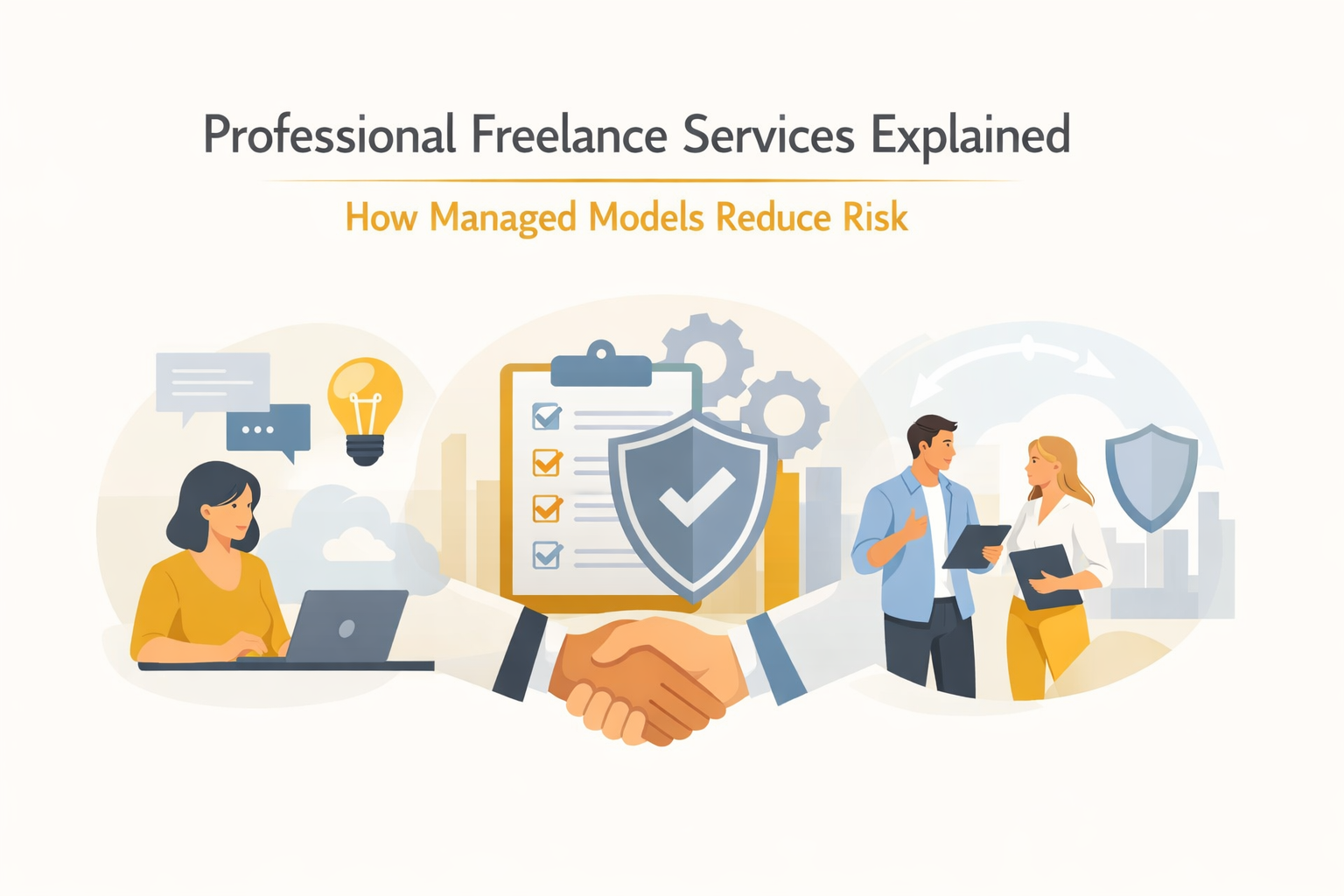
Founders often start with freelancers for speed. Growth leaders scale with agencies for structure. And somewhere between cost control and delivery pressure, many teams hit the same wall: inconsistent quality, fragmented ownership, and unpredictable ROI.
Why do most growth strategies fail after month three?
Because execution risk compounds faster than strategy clarity.
That’s where professional freelance services-delivered through a managed model-change the equation. Instead of juggling vendors, chasing timelines, and re-briefing new talent, businesses gain structured access to professional service providers with accountability built in.
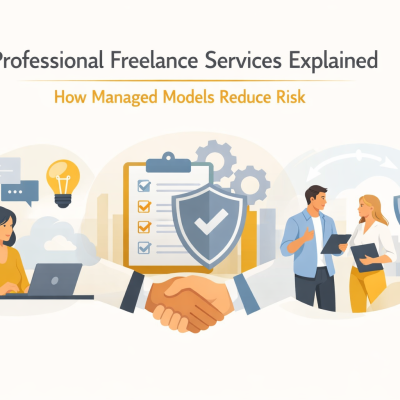
This guide explains how managed freelance models reduce operational risk, improve delivery reliability, and support predictable growth-without agency overhead.
What Are Professional Freelance Services in a Managed Model?
Traditional freelancing is talent-first.
Managed freelance services are outcome-first.
Professional freelance services refer to structured engagements where vetted specialists deliver defined business outcomes under a centralized management layer. In a managed model, execution is coordinated by a delivery partner who ensures:
- Talent matching based on business goals
- Process governance and quality assurance
- Performance monitoring and reporting
- Strategic continuity across initiatives
In practice, this blends the agility of freelancers with the reliability of managed professional services.
If you want a deeper conceptual breakdown, see What Are Managed Professional Services – A Smarter Alternative to Traditional Agencies.
For B2B teams evaluating outsourced digital services or outsourced marketing services, the managed approach reduces the friction typically associated with hiring independent experts.
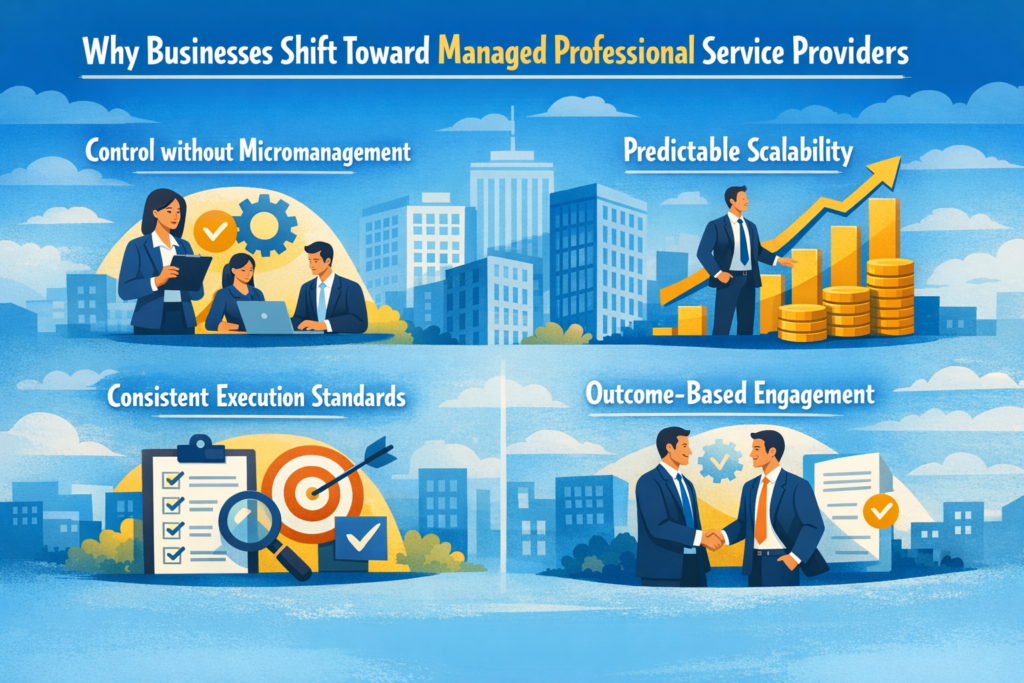
Why Businesses Shift Toward Managed Professional Service Providers
Growth-stage SaaS teams, e-commerce brands, and B2B service firms often share a common pain pattern:
- Too many vendors, not enough ownership
- Strategy and execution disconnected
- Scaling creates coordination chaos
- ROI becomes difficult to attribute
The shift toward managed professional service providers is less about outsourcing-and more about risk transfer with accountability.
The Core Value Drivers
1. Control without micromanagement
You maintain strategic direction while delivery is structured and supervised.
2. Predictable scalability
Teams expand or contract based on business demand-not hiring cycles.
3. Consistent execution standards
Processes, documentation, and QA replace individual working styles.
4. Outcome-based engagement
Success is defined by performance-not hours billed.
Growth leaders usually ask: “Can outsourced teams really align with internal strategy?”
Managed models exist specifically to solve that alignment gap.
If you’re comparing operational models, read Outsourced Digital Services vs Hiring In-House: What’s Better for Businesses.
Traditional Freelancers vs Managed Freelance Services
| Factor | Traditional Freelancers | Managed Professional Freelance Services |
| Talent sourcing | Client responsibility | Curated and matched |
| Project coordination | Client-managed | Centralized management |
| Quality assurance | Inconsistent | Standardized QA process |
| Scalability | Manual hiring | Structured scaling |
| Risk exposure | High | Reduced through governance |
| Strategic continuity | Fragmented | Managed oversight |
| Reporting | Limited | Performance-driven |
| Cost predictability | Variable | Structured engagement |
For businesses evaluating marketing experts for hire or digital marketing experts, the real difference is not skill-it’s delivery infrastructure.
How Managed Models Reduce Operational Risk
Risk in outsourced work rarely comes from talent capability.
It comes from process gaps, misalignment, and lack of accountability.
Managed freelance services address risk across four dimensions.
1. Talent Risk → Solved by Vetting + Matching
Not every expert fits every growth stage. Managed providers match specialists based on:
- Industry experience
- Business model familiarity
- Growth maturity level
- Performance expectations
This prevents the common scenario where capable freelancers deliver the wrong outcomes.
2. Execution Risk → Solved by Delivery Governance
Managed models introduce structure:
- Clear scope frameworks
- Milestone-based workflows
- Communication protocols
- Documentation standards
For marketing services for small businesses, this eliminates operational guesswork.
(Explore Best Outsourced Marketing Services for Small Businesses.)
3. Quality Risk → Solved by Layered Review
Quality assurance isn’t optional-it’s systemic.
- Work reviews
- Performance benchmarks
- Continuous optimization
- Strategic supervision
The result: fewer revisions, faster outcomes, better ROI clarity.
4. Continuity Risk → Solved by Relationship Management
Freelancer churn is a silent growth killer. Managed services provide continuity through:
- Dedicated relationship manager
- Knowledge retention systems
- Replacement without disruption
- Strategic alignment across projects
This is especially valuable for ongoing outsourced business solutions like SEO, performance marketing, and growth strategy execution.
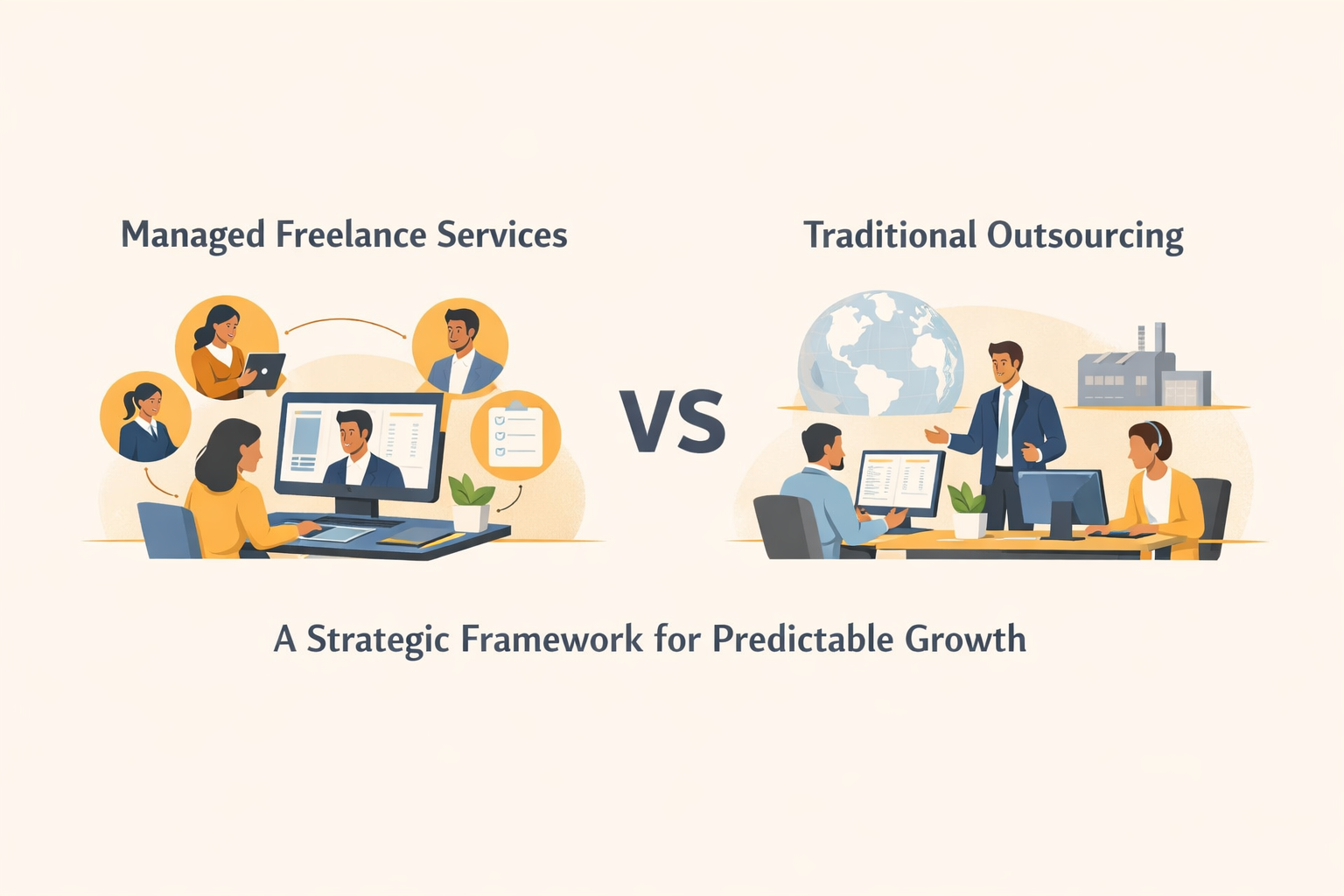
If you want the strategic framework, read Managed Freelance Services vs Traditional Outsourcing – A Strategic Framework for Predictable Growth.
Where Managed Professional Freelance Services Deliver the Most Value
Managed models are not a universal solution. They are most impactful when:
SaaS Growth Teams Need Speed + Structure
Product launches, acquisition experiments, and content scaling require coordinated expertise across channels.
B2B Companies Need Predictable Marketing Execution
Lead generation pipelines depend on consistent performance-not one-off campaigns.
E-commerce Brands Need Scalable Performance Marketing
Media buying, CRO, and creative production must operate as a unified system.
(See Performance Marketing Services.)
Startups Need Senior Expertise Without Hiring Risk
Access to high-level specialists without long-term payroll commitment.
In each case, the business objective is the same: reduce execution uncertainty while scaling outcomes.
How the Managed Model Works in Practice
A typical managed professional freelance engagement includes:
Step 1: Strategic Alignment
Define business objectives, KPIs, and growth priorities.
Step 2: Expert Matching
Select specialists based on outcome requirements-not availability.
Step 3: Managed Execution
Delivery coordinated through structured workflows and reporting.
(Explore Growth Marketing Services.)
Step 4: Performance Optimization
Continuous improvement based on measurable results.
Step 5: Scalable Expansion
Add capabilities without rebuilding the team structure.
This framework transforms outsourcing from a tactical decision into a growth infrastructure.
The Role of Managed Freelance Services in Modern Growth Strategy
Digital growth today is interdisciplinary. SEO affects performance marketing. Content impacts conversion. Analytics drives strategy.
Fragmented execution weakens performance. Managed professional freelance services solve this through coordinated delivery across:
- SEO execution
- Growth marketing strategy
- Performance marketing management
- Conversion optimization
- Content production
- UX and product interface delivery
(Explore Design & Development Services and Content Marketing Services.)
This integrated approach is why many companies now prefer managed freelance services over traditional agencies or marketplaces.
How We The Freelancer (WTF) Structures Risk-Reduced Delivery
A managed freelance model only works when process, talent, and accountability operate as a unified system.
WTF’s managed structure focuses on three pillars:
Relationship-Led Coordination
A dedicated relationship manager ensures alignment between business objectives and execution priorities.
Structured Quality Assurance
Every deliverable follows defined standards, review cycles, and performance benchmarks.
Outcome-Oriented Service Model
Engagements are built around growth outcomes-not task completion.
For organizations evaluating outsourced digital services with executive-level reliability, this structure bridges the gap between freelance flexibility and agency-level accountability.
How to Evaluate a Professional Freelance Services Partner
Before selecting a managed service provider, growth leaders typically assess:
Strategic Alignment Capability
Do they understand business outcomes beyond execution tasks?
Delivery Governance Framework
Is there a defined process for quality, reporting, and coordination?
Talent Matching Methodology
How are experts selected and evaluated?
Scalability Structure
Can services expand without operational disruption?
Performance Accountability
Are results tracked against business KPIs?
FAQ: Professional Freelance Services & Managed Models
What are professional freelance services?
Professional freelance services are structured engagements where vetted specialists deliver business outcomes under defined processes and performance expectations.
How do managed freelance services reduce risk?
They reduce risk through talent vetting, delivery governance, quality assurance, and centralized accountability.
Are managed freelance services better than agencies?
They offer greater flexibility and cost efficiency while maintaining structured delivery oversight.
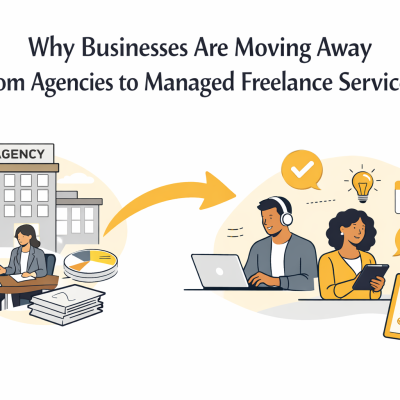
(See Why Businesses Are Moving Away from Agencies to Managed Freelance Services.)
Who should use managed professional service providers?
Growth-stage companies, SaaS firms, and B2B organizations seeking scalable expertise without hiring overhead.
What types of services are commonly managed?
SEO, growth marketing, performance marketing, content strategy, analytics, and conversion optimization.
The Strategic Takeaway
Professional freelance services are evolving from transactional hiring into managed growth infrastructure.
For founders and marketing leaders balancing control, scalability, and reliability, the question is no longer whether to outsource-but how to outsource without increasing risk.
Managed freelance models provide a clear answer:
Structured execution
Accountable delivery
Predictable growth support
When outsourcing becomes governed, aligned, and outcome-driven, it stops being a cost decision-and becomes a strategic advantage.
If your next growth phase depends on reliable execution rather than more vendors, managed professional freelance services may be the most practical path forward.
If you’re evaluating partners now, you can schedule a strategy discussion or contact the team.