The Real Question Isn’t Cost — It’s Control, Speed, and Outcomes
Every growth-stage business eventually hits the same wall.
Marketing velocity slows. Product releases slip. Campaign performance plateaus. And suddenly, the question lands on the leadership table:
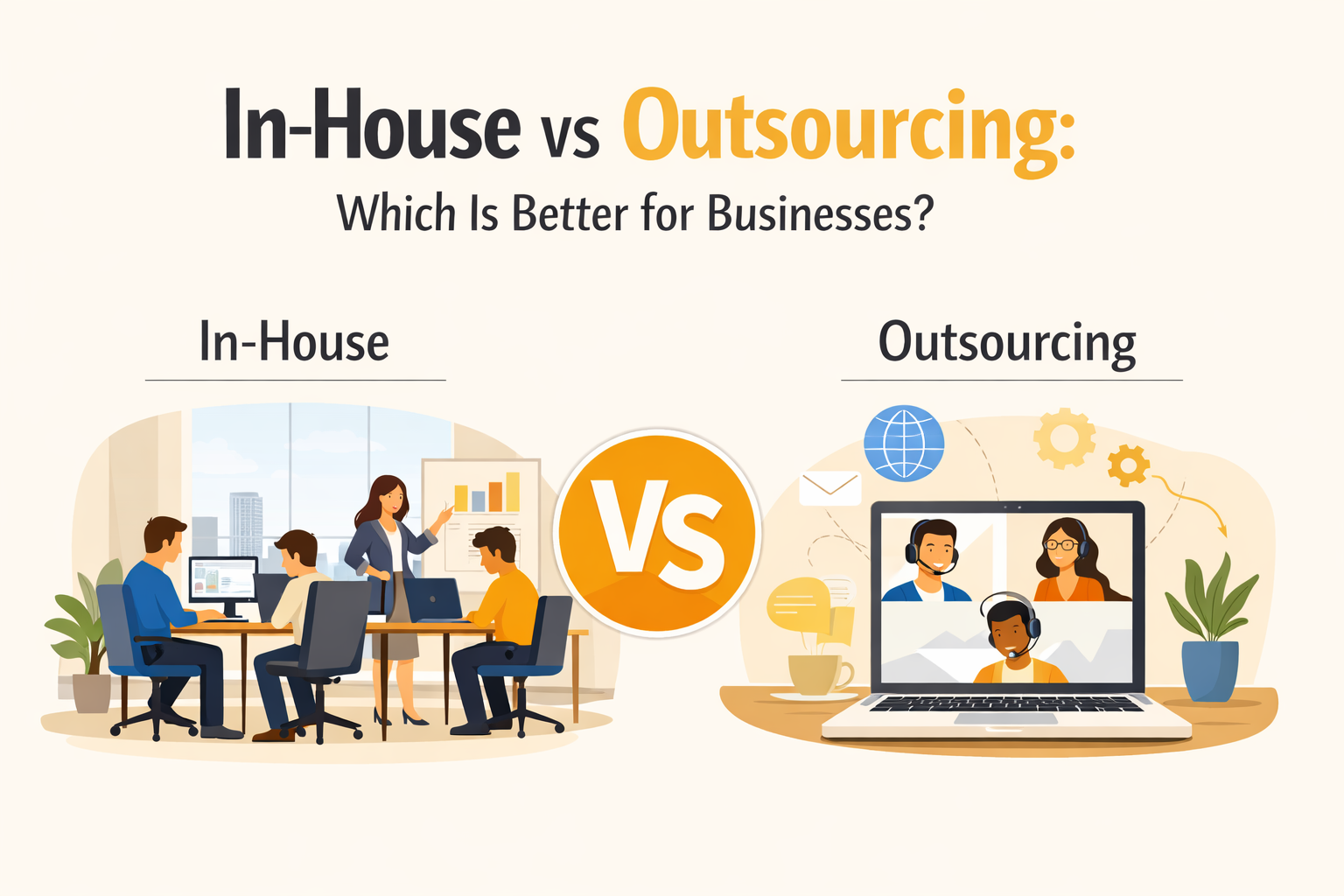
Should we build an in-house team, or outsource digital services?
On the surface, this looks like a budget decision. In reality, it’s a strategic operating choice that shapes your speed to market, execution quality, scalability, and long-term growth efficiency.
Founders often struggle with this tradeoff. Growth leaders usually ask:
- Will outsourcing reduce quality or control?
- Is hiring in-house more reliable long-term?
- Which model actually scales better?
In this guide, we break down the in-house vs outsourcing decision with a practical, executive-friendly framework — grounded in real delivery models used by SaaS companies, digital-first enterprises, and high-growth teams.
In-House vs Outsourcing: A Quick Definition
Before comparing models, let’s clarify what each approach really means in modern digital delivery.
What “Hiring In-House” Typically Involves
- Full-time employees on payroll
- Fixed monthly cost (salary, benefits, tools, management)
- Internal culture, training, performance management
- Long-term ownership of skills and knowledge
What “Outsourced Digital Services” Usually Means
- External specialists, agencies, or managed service partners
- Flexible engagement (project-based, retainer, or dedicated teams)
- Faster access to niche skills and delivery capacity
- Variable cost tied to output and performance
In practice, today’s outsourcing spans three models:
- Agencies
- Freelance marketplaces
- Managed professional services (like We The Freelancer’s managed freelance model)
Each behaves very differently — and this distinction matters.
High-Level Comparison: In-House vs Outsourced Digital Services
| Factor | In-House Team | Outsourced Digital Services |
|---|---|---|
| Cost Structure | High fixed cost | Variable, usage-based |
| Hiring Speed | Slow (4–12 weeks) | Fast (days to 2 weeks) |
| Skill Breadth | Limited to team size | Wide, on-demand expertise |
| Scalability | Rigid | Highly flexible |
| Control | High | Medium–High (depends on model) |
| Management Overhead | High | Low to moderate |
| Risk | Hiring mistakes, attrition | Vendor dependency, quality variance |
This table explains what changes.
Now let’s explore when each model actually works best.
When Should You Hire In-House?
Hiring in-house makes strategic sense when:
1. The Function Is Core to Your IP or Competitive Advantage
If digital execution is your product or your moat — product engineering, proprietary data science, or platform development — internal ownership matters.
2. Workload Is Predictable and Long-Term
In-house teams perform best when:
- Demand is stable
- Roadmaps are well defined
- Skill requirements don’t change frequently
3. You Need Deep Institutional Knowledge
Some functions benefit from context that only internal teams accumulate over time:
- Product strategy
- Internal analytics
- Long-term brand architecture
4. You Can Afford the Full Operating Cost
True in-house cost is rarely just salary. It includes:
- Hiring and onboarding
- Management time
- Tools and infrastructure
- Attrition and replacement risk
Hidden reality:
In many mid-stage companies, 30–40% of in-house cost is operational overhead, not delivery.
When Does Outsourcing Make More Strategic Sense?
Outsourcing outperforms in-house hiring when:
1. You Need Speed and Flexibility
Launching campaigns, scaling performance marketing, or building growth infrastructure often requires:
- Immediate capacity
- Rapid experimentation
- Changing skill mixes
Outsourcing compresses hiring cycles from months to weeks.
2. Skills Are Specialized or Short-Term
SEO specialists, CRO experts, performance marketers, data engineers — these profiles are:
- Expensive to hire full-time
- Hard to retain
- Underutilized after project completion
3. You’re Scaling Faster Than Your Hiring Pipeline
Startups and growth-stage firms often face:
- Hiring bottlenecks
- Unfilled roles slowing revenue growth
- Overloaded internal teams
Outsourcing absorbs volatility without increasing long-term fixed cost.
4. You Want Output Accountability, Not Headcount Ownership
Modern managed services focus on:
- Delivery SLAs
- Quality benchmarks
- Performance reporting
This shifts leadership focus from managing people to managing outcomes.
Cost Breakdown: Is Outsourcing Really Cheaper Than Hiring In-House?
This is where many decisions go wrong.
True Cost of In-House (Per Mid-Level Digital Role)
- Base salary
- Benefits & payroll tax
- Recruitment cost
- Onboarding & ramp-up
- Managerial overhead
- Tools & licenses
Typical annual cost: 1.4x – 1.7x base salary
A $60,000 role often costs $85,000–$100,000+ annually.
True Cost of Outsourced Digital Services
Depends heavily on the model:
| Model | Cost Efficiency | Risk |
|---|---|---|
| Agencies | High cost, bundled | Low control |
| Marketplaces | Low cost | High quality risk |
| Managed services | Optimized | Low operational risk |
In managed freelance services, like We The Freelancer’s model:
- You pay for productive hours, not idle capacity
- No recruitment or attrition cost
- Built-in QA and delivery oversight
Result:
Lower effective cost per output, not just per hour.
Quality, Control & Reliability: The Real Differentiator
This is where the decision usually gets emotional.
In-House Advantages
- Direct supervision
- Cultural alignment
- Deep product understanding
Outsourcing Risks (Traditional Models)
- Inconsistent quality
- Communication gaps
- Vendor turnover
- Lack of accountability
Where Managed Services Change the Equation
High-performance outsourcing today looks very different:
At We The Freelancer (WTF), for example:
- Dedicated relationship managers coordinate delivery
- Vetted specialists matched to each engagement
- Multi-layer quality assurance
- Performance tracking at task and campaign level
This hybrid model preserves:
- Control
- Reliability
- Institutional continuity
While keeping:
- Flexibility
- Speed
- Cost efficiency
Decision Framework: In-House or Outsource?
Use this executive-level decision filter.
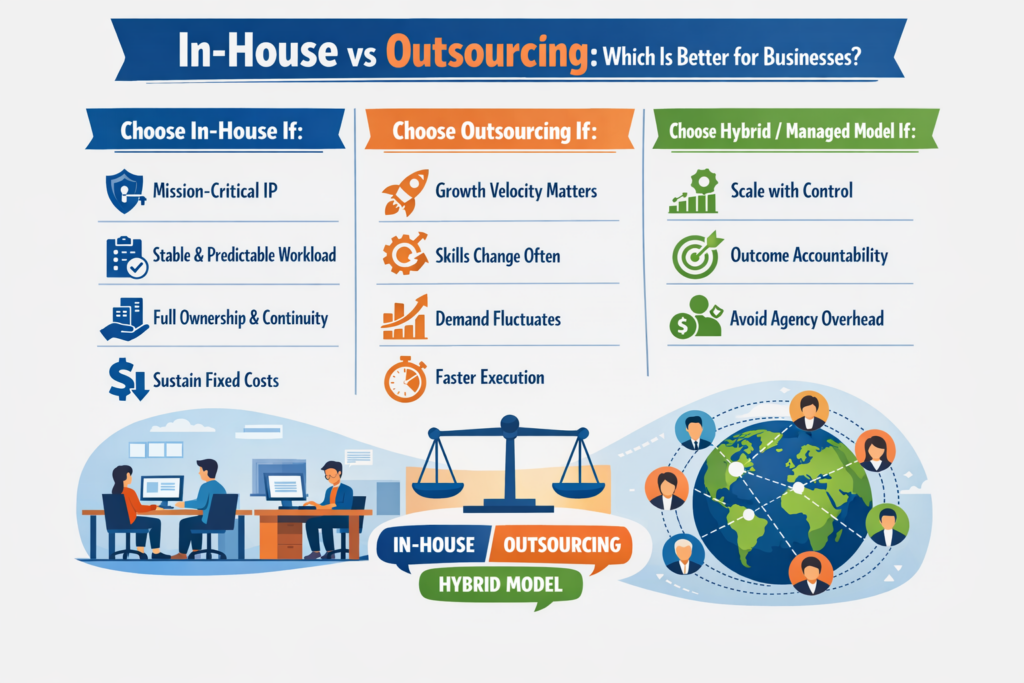
Choose In-House If:
- The function is mission-critical IP
- Workload is stable and predictable
- You need full ownership and long-term continuity
- You can sustain fixed cost even in slow cycles
Choose Outsourcing If:
- Growth velocity matters more than ownership
- Skills change frequently
- Demand fluctuates
- You want faster execution without permanent headcount
Choose a Hybrid / Managed Model If:
- You need scale with control
- You want outcome accountability
- You want to avoid agency overhead and freelancer chaos
This is where outsourcing vs hiring in house becomes less binary — and more architectural.
Real-World Scenarios
SaaS Growth Team
Needs SEO, performance marketing, analytics, CRO.
Hiring 4 specialists in-house = slow, expensive, high risk.
Managed outsourcing = immediate skill coverage, scalable delivery.
E-commerce Brand
Campaign peaks during sales cycles.
In-house teams underutilized in off-season.
Outsourcing absorbs demand volatility without layoffs or burnout.
B2B Services Firm
Needs predictable lead flow, content, automation.
Hybrid model works best:
Core strategy in-house, execution outsourced with delivery governance.
FAQs: In-House vs Outsourcing
It depends on speed, scale, and skill volatility. For most growth teams, outsourcing with a managed model delivers higher ROI and lower execution risk.
Early-stage startups benefit most from outsourcing. It preserves capital, accelerates go-to-market, and avoids premature hiring mistakes.
Only in unmanaged models. With proper QA, relationship management, and delivery governance, outsourced quality often exceeds early in-house teams.
When measured by cost per outcome, not hourly rates — yes, especially in specialized digital functions.
How We The Freelancer Fits Into This Decision
Most companies don’t fail because they chose in-house or outsourcing.
They fail because they chose:
- The wrong model
- The wrong partner
- Or no delivery governance
We The Freelancer (WTF) operates as a managed freelance services partner — combining:
- Curated specialist talent
- Dedicated relationship managers
- Multi-layer quality assurance
- Flexible scaling without agency overhead
This positions WTF as:
- An alternative to agencies
- A safer option than marketplaces
- A scalable extension of in-house teams
Conclusion: In-House vs Outsourcing — Which Is Better?
So, in house vs outsourcing — which is better?
The honest answer:
- In-house wins on ownership and continuity
- Outsourcing wins on speed, flexibility, and specialization
- Managed services win on balance
For modern growth teams, the most resilient model is not choosing one — but designing the right blend.
If your goal is:
- Predictable growth
- Controlled execution
- Scalable delivery
- Reduced operational risk
Then outsourced digital services with managed governance increasingly outperform traditional hiring.
Ready to Make the Right Delivery Decision?
If you’re currently weighing in-house hiring vs outsourced digital services, the right answer depends on your growth stage, operating model, and performance goals — not generic benchmarks.
At We The Freelancer (WTF), we help founders, marketing leaders, and product teams design scalable delivery models using managed freelance services, dedicated specialists, and outcome-driven execution — without agency overhead or hiring risk.
If you’d like an expert perspective on:
- What to keep in-house
- What to outsource
- How to reduce delivery risk and improve ROI
Book a strategic consultation with our team.
We’ll review your current setup, growth objectives, and execution gaps — and recommend a delivery model built for predictable, sustainable growth.
No pitches. No templates. Just practical guidance from people who build and scale digital teams every day.