

The real problem isn’t finding talent – it’s trusting delivery Every growth – stage company eventually hits the same friction point: execution demand rises faster than hiring capacity. Campaigns need to launch, funnels need optimization, and specialized skills are required now – not after a 10 – week recruitment cycle. Founders often struggle with a familiar tension: This is why more B2B leaders choose to hire vetted freelancers through structured, managed delivery models. But “vetted” alone doesn’t eliminate risk. The real safeguard is process + governance + accountability. This guide explains exactly how to hire vetted freelancers without risk – using a practical, executive – ready framework built for modern outsourced digital services. What “Vetted Freelancers” Actually Means in B2B Delivery In premium professional freelance services, “vetted” is not a marketing label – it’s a structured evaluation system designed to protect outcomes. A true vetting process typically includes: Why does this matter? Because most delivery failures don’t come from lack of skill. They come from misalignment, poor accountability, and inconsistent oversight. That’s why growth leaders increasingly rely on managed professional services rather than independent hiring. When Businesses Should Hire Vetted Freelancers Hiring vetted talent makes strategic sense when: Typical use cases include: In other words: execution – heavy, expertise – driven work. Step – by – Step Framework to Hire Vetted Freelancers Without Risk Step 1 – Define Outcomes, Not Roles Why do most growth initiatives stall after month three? Because companies hire “people” instead of defining outcomes. Before engaging any professional service providers, clarify: Example: ❌ “Hire a digital marketer”✅ “Increase qualified pipeline by 25% within 6 months” Outcome clarity reduces misalignment before work begins. Step 2 – Choose the Right Engagement Model Not all outsourced digital services operate the same way. Your risk level depends heavily on structure. Model Control Quality Consistency Operational Risk Freelance marketplaces Low Variable High Traditional agencies Medium Structured Medium Managed freelance services High Governed Low Growth leaders typically choose structured delivery models because they combine flexibility with accountability. This is where managed professional services become strategically valuable. Step 3 – Validate Capability Through Process, Not Portfolios Portfolios show past work. They do not guarantee future delivery. Instead, evaluate: Ask questions like: Risk decreases when responsibility is explicit. Step 4 – Establish Governance Before Work Begins Most outsourced failures occur due to missing governance – not poor talent. Essential governance components include: ✔ Clear scope of work✔ Defined success metrics✔ Reporting cadence✔ Performance review checkpoints✔ Change management process✔ Delivery oversight ownership When governance exists, outsourcing becomes predictable. Step 5 – Prioritize Delivery Management Over Talent Sourcing Here’s a critical insight: Talent quality matters less than delivery management structure. Even exceptional digital marketing experts require coordination, context, and oversight to perform consistently. That’s why high – performance organizations increasingly use managed freelance services where: This transforms outsourcing from transactional hiring into a managed growth system. A practical example is the managed freelance model offered by We The Freelancer, where delivery governance sits between the business and the specialist – preserving control while reducing operational burden. Risk Comparison: Hiring Independently vs Managed Delivery Risk Area Independent Hiring Managed Professional Services Talent mismatch High Low Quality variance High Governed Delivery oversight Internal burden Built – in Scalability Limited Flexible Accountability Diffuse Structured Operational stress High Reduced For growth – stage organizations, predictability often matters more than raw cost. Real – World Business Scenarios SaaS Growth Team Needs SEO, CRO, and performance marketing expertise simultaneously. Hiring internally = slow scalingHiring freelancers individually = coordination complexityManaged model = unified execution with measurable outcomes E – commerce Brand Experiences seasonal demand spikes. Internal teams underutilized off – seasonMarketplace freelancers inconsistentManaged freelance services provide elastic capacity with reliability B2B Services Firm Requires continuous pipeline generation. Strategy stays internalExecution outsourced to marketing experts for hireGovernance ensures consistency and performance tracking How Managed Professional Services Reduce Freelance Risk Traditional outsourcing often fails because it shifts responsibility to the client. Managed delivery reverses that dynamic. A mature managed professional services model includes: This structure preserves three things business leaders care about most: ✔ Control✔ Reliability✔ Predictable growth Internal Implementation Checklist If you plan to hire vetted freelancers, ensure your process includes: Without these elements, even top talent cannot guarantee results. FAQ: Hiring Vetted Freelancers for Business Growth Strategic Takeaway: Risk Reduction Comes From Structure Businesses don’t struggle because they hire freelancers. They struggle because they hire without governance. To hire vetted freelancers without risk, focus on: When outsourcing is structured properly, it becomes a scalable execution engine – not a risk. For organizations seeking predictable growth without expanding internal headcount, managed freelance services increasingly function as a strategic operating model rather than a hiring tactic. Conclusion: Hire Vetted Freelancers With Confidence To hire vetted freelancers effectively, businesses must move beyond talent sourcing and adopt structured outsourced digital services with built – in delivery governance. When execution is coordinated, quality assured, and outcomes measured, outsourcing transforms from a tactical decision into a strategic growth advantage. For modern B2B teams navigating speed, scale, and specialization, managed professional services provide the balance between flexibility and control – enabling reliable execution without hiring risk. you can schedule a strategy discussion or contact the team.
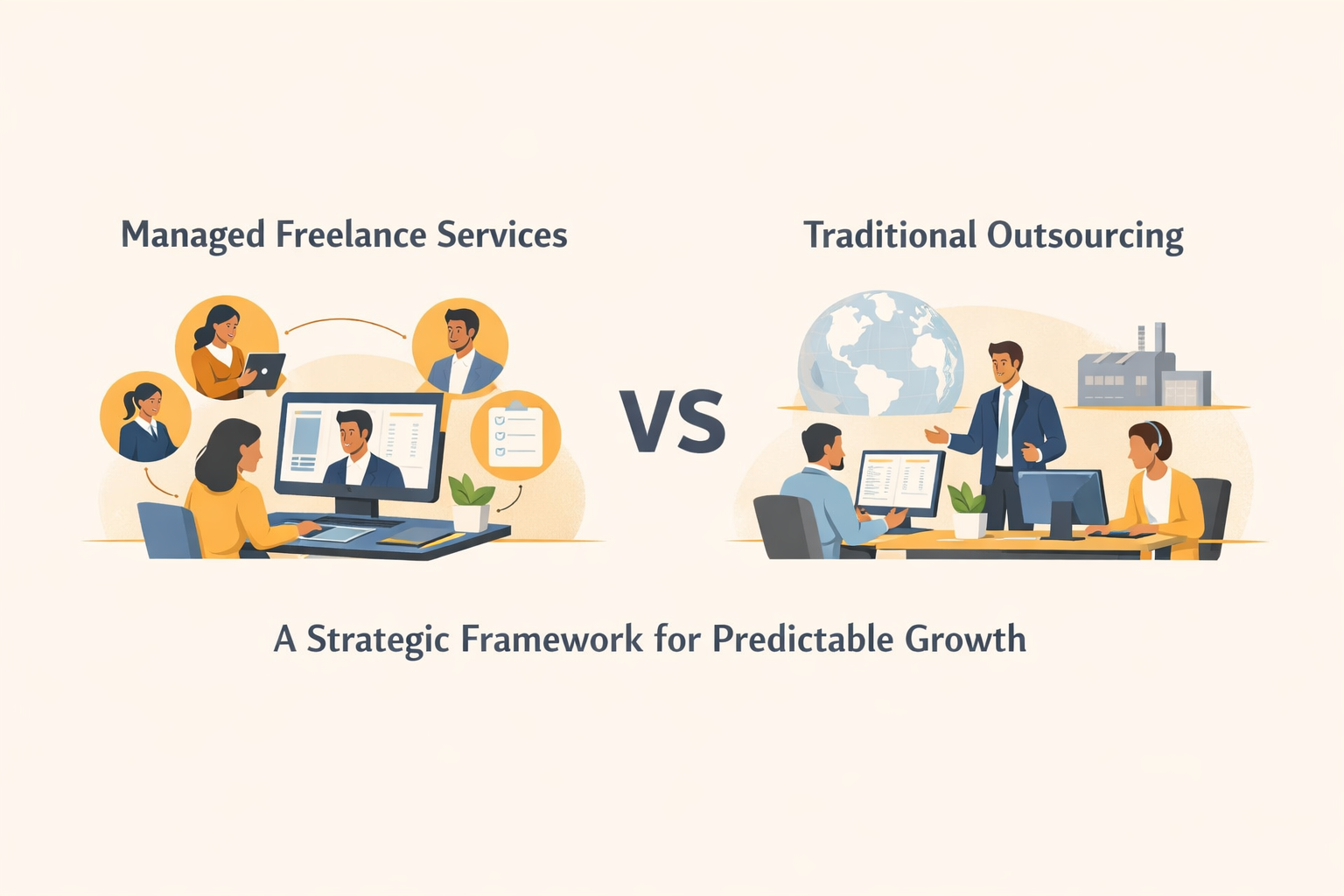
Managed Freelance Services vs Traditional Outsourcing: A Strategic Framework for Predictable Growth
Founders often scale fast and then hit the same wall. Freelancers become inconsistent. Agencies become expensive. Internal teams become overloaded.Growth slows not because strategy failed… but because delivery became unpredictable. So the real executive question isn’t “Should we outsource?”It’s “What operating model gives us control, scalability, and reliable execution?” That’s where managed freelance services enter the conversation. This guide breaks down how the model works, when it outperforms agencies and marketplaces, and how B2B growth teams use it to stabilize execution without inflating overhead. What Are Managed Freelance Services? Managed freelance services combine the flexibility of independent specialists with the structure, accountability, and quality control of a professional service partner. Instead of hiring freelancers individually or outsourcing to a large agency, businesses engage a managed provider that: In practice, this creates a delivery layer between strategy and execution something most scaling companies lack. A structured provider like We The Freelancer (WTF) operates as an embedded growth partner, not a marketplace or staffing vendor. Why Do Most Growth Strategies Fail After Month Three? Growth leaders usually ask this after launching campaigns, content initiatives, or performance programs that start strong then plateau. The pattern is predictable: Stage What Happens Root Cause Month 1 Strategy and launch energy Leadership attention is high Month 2 Execution begins to fragment Multiple vendors, unclear ownership Month 3 Performance stagnates No operational accountability Month 4+ Cost rises, ROI unclear Delivery model is reactive The issue isn’t capability it’s operational structure. Managed freelance services solve this by introducing: Managed Freelance Services vs Agencies vs Marketplaces Executives evaluating delivery partners typically compare three models. The strategic differences are operational, not cosmetic. Comparison Framework Factor Managed Freelance Services Traditional Agency Freelance Marketplace Execution Model Managed specialists with oversight Centralized internal team Self-managed contractors Cost Structure Predictable, scalable High retainers Variable, unpredictable Quality Assurance Built-in governance Agency-dependent Client responsibility Scalability Modular, flexible Resource-constrained Coordination-heavy Accountability Dedicated relationship manager Account manager None Speed of Deployment High Medium Variable Risk Exposure Low Medium High Strategic Alignment Continuous optimization Campaign-based Task-based Key insight:Marketplaces optimize for talent access.Agencies optimize for service packaging.Managed freelance services optimize for delivery outcomes. That distinction changes ROI trajectories over time. When Should Businesses Choose Managed Freelance Services? Not every organization needs this model. But high-growth and performance-driven teams consistently benefit in specific scenarios. Ideal Use Cases 1. Scaling Without Hiring 2. Replacing Fragmented Vendor Ecosystems 3. Seeking Predictable Growth Infrastructure 4. Needing Specialized Expertise On-Demand Growth leaders typically choose this model when they want:✔ Control without hiring✔ Expertise without agency overhead✔ Scalability without operational chaos How the Managed Freelance Delivery Framework Works A mature managed model operates through a structured lifecycle not ad-hoc outsourcing. Step 1: Growth Objective Alignment Business goals translate into measurable execution roadmaps. Example: Step 2: Specialist Matching and Team Structuring Instead of hiring one generalist, the provider assembles a modular team: Step 3: Relationship Management Layer This is the differentiator most companies underestimate. The relationship manager: Step 4: Continuous Optimization Cycle Execution becomes a loop:Plan → Execute → Measure → Improve This shifts outsourcing from reactive to proactive the same advantage that made managed IT dominant in enterprise operations. Strategic Advantages for B2B Growth Leaders 1. Operational Control Without Employment Risk Scaling teams often struggle between hiring and outsourcing. Managed freelance services provide a third path controlled external execution. 2. Predictable Cost Structure Unlike agencies that bundle services or freelancers who bill unpredictably, managed models align cost with output and scope. 3. Reliability at Scale Consistency is the hidden growth multiplier. Governance frameworks ensure: 4. Faster Strategic Iteration Because specialists are modular, teams can pivot faster: Real-World Business Scenario Scenario: B2B SaaS Expansion Challenge:A SaaS company wants to grow inbound pipeline globally but cannot justify hiring a full internal growth team. Traditional Options: Managed Freelance Model Outcome: Business impact:✔ Lower operational friction✔ Continuous execution✔ Improved marketing ROI visibility FAQ: Managed Freelance Services for B2B Companies The Strategic Takeaway The outsourcing conversation is evolving. Businesses no longer choose between:Hiring internallyOROutsourcing externally They choose how execution is governed. Managed freelance services represent a structural shift from vendor management to delivery partnership. For growth-focused organizations, the real value isn’t cheaper execution.It’s predictable, scalable, accountable growth infrastructure. And in competitive B2B markets, operational reliability becomes a strategic advantage. Book a strategic consultation with our team.We’ll review your current setup, growth objectives, and execution gaps — and recommend a delivery model built for predictable, sustainable growth.
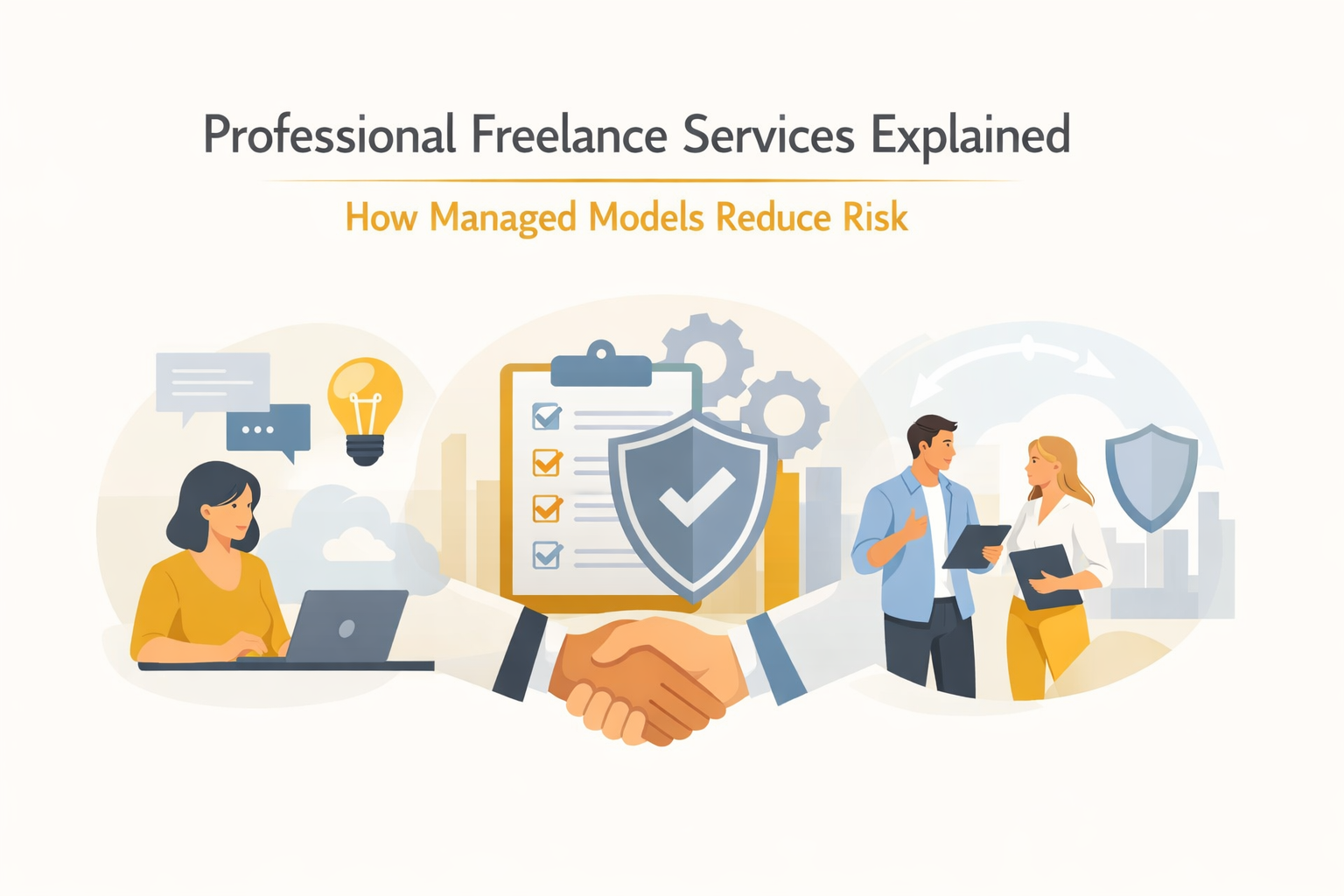
Professional Freelance Services Explained: How Managed Models Reduce Risk
Founders often start with freelancers for speed. Growth leaders scale with agencies for structure. And somewhere between cost control and delivery pressure, many teams hit the same wall: inconsistent quality, fragmented ownership, and unpredictable ROI. Why do most growth strategies fail after month three?Because execution risk compounds faster than strategy clarity. That’s where professional freelance services-delivered through a managed model-change the equation. Instead of juggling vendors, chasing timelines, and re-briefing new talent, businesses gain structured access to professional service providers with accountability built in. This guide explains how managed freelance models reduce operational risk, improve delivery reliability, and support predictable growth-without agency overhead. What Are Professional Freelance Services in a Managed Model? Traditional freelancing is talent-first.Managed freelance services are outcome-first. Professional freelance services refer to structured engagements where vetted specialists deliver defined business outcomes under a centralized management layer. In a managed model, execution is coordinated by a delivery partner who ensures: In practice, this blends the agility of freelancers with the reliability of managed professional services. If you want a deeper conceptual breakdown, see What Are Managed Professional Services – A Smarter Alternative to Traditional Agencies. For B2B teams evaluating outsourced digital services or outsourced marketing services, the managed approach reduces the friction typically associated with hiring independent experts. Why Businesses Shift Toward Managed Professional Service Providers Growth-stage SaaS teams, e-commerce brands, and B2B service firms often share a common pain pattern: The shift toward managed professional service providers is less about outsourcing-and more about risk transfer with accountability. The Core Value Drivers 1. Control without micromanagementYou maintain strategic direction while delivery is structured and supervised. 2. Predictable scalabilityTeams expand or contract based on business demand-not hiring cycles. 3. Consistent execution standardsProcesses, documentation, and QA replace individual working styles. 4. Outcome-based engagementSuccess is defined by performance-not hours billed. Growth leaders usually ask: “Can outsourced teams really align with internal strategy?”Managed models exist specifically to solve that alignment gap. If you’re comparing operational models, read Outsourced Digital Services vs Hiring In-House: What’s Better for Businesses. Traditional Freelancers vs Managed Freelance Services Factor Traditional Freelancers Managed Professional Freelance Services Talent sourcing Client responsibility Curated and matched Project coordination Client-managed Centralized management Quality assurance Inconsistent Standardized QA process Scalability Manual hiring Structured scaling Risk exposure High Reduced through governance Strategic continuity Fragmented Managed oversight Reporting Limited Performance-driven Cost predictability Variable Structured engagement For businesses evaluating marketing experts for hire or digital marketing experts, the real difference is not skill-it’s delivery infrastructure. How Managed Models Reduce Operational Risk Risk in outsourced work rarely comes from talent capability.It comes from process gaps, misalignment, and lack of accountability. Managed freelance services address risk across four dimensions. 1. Talent Risk → Solved by Vetting + Matching Not every expert fits every growth stage. Managed providers match specialists based on: This prevents the common scenario where capable freelancers deliver the wrong outcomes. 2. Execution Risk → Solved by Delivery Governance Managed models introduce structure: For marketing services for small businesses, this eliminates operational guesswork.(Explore Best Outsourced Marketing Services for Small Businesses.) 3. Quality Risk → Solved by Layered Review Quality assurance isn’t optional-it’s systemic. The result: fewer revisions, faster outcomes, better ROI clarity. 4. Continuity Risk → Solved by Relationship Management Freelancer churn is a silent growth killer. Managed services provide continuity through: This is especially valuable for ongoing outsourced business solutions like SEO, performance marketing, and growth strategy execution. If you want the strategic framework, read Managed Freelance Services vs Traditional Outsourcing – A Strategic Framework for Predictable Growth. Where Managed Professional Freelance Services Deliver the Most Value Managed models are not a universal solution. They are most impactful when: SaaS Growth Teams Need Speed + Structure Product launches, acquisition experiments, and content scaling require coordinated expertise across channels. B2B Companies Need Predictable Marketing Execution Lead generation pipelines depend on consistent performance-not one-off campaigns. E-commerce Brands Need Scalable Performance Marketing Media buying, CRO, and creative production must operate as a unified system.(See Performance Marketing Services.) Startups Need Senior Expertise Without Hiring Risk Access to high-level specialists without long-term payroll commitment. In each case, the business objective is the same: reduce execution uncertainty while scaling outcomes. How the Managed Model Works in Practice A typical managed professional freelance engagement includes: Step 1: Strategic Alignment Define business objectives, KPIs, and growth priorities. Step 2: Expert Matching Select specialists based on outcome requirements-not availability. Step 3: Managed Execution Delivery coordinated through structured workflows and reporting.(Explore Growth Marketing Services.) Step 4: Performance Optimization Continuous improvement based on measurable results. Step 5: Scalable Expansion Add capabilities without rebuilding the team structure. This framework transforms outsourcing from a tactical decision into a growth infrastructure. The Role of Managed Freelance Services in Modern Growth Strategy Digital growth today is interdisciplinary. SEO affects performance marketing. Content impacts conversion. Analytics drives strategy. Fragmented execution weakens performance. Managed professional freelance services solve this through coordinated delivery across: This integrated approach is why many companies now prefer managed freelance services over traditional agencies or marketplaces. How We The Freelancer (WTF) Structures Risk-Reduced Delivery A managed freelance model only works when process, talent, and accountability operate as a unified system. WTF’s managed structure focuses on three pillars: Relationship-Led Coordination A dedicated relationship manager ensures alignment between business objectives and execution priorities. Structured Quality Assurance Every deliverable follows defined standards, review cycles, and performance benchmarks. Outcome-Oriented Service Model Engagements are built around growth outcomes-not task completion. For organizations evaluating outsourced digital services with executive-level reliability, this structure bridges the gap between freelance flexibility and agency-level accountability. How to Evaluate a Professional Freelance Services Partner Before selecting a managed service provider, growth leaders typically assess: Strategic Alignment CapabilityDo they understand business outcomes beyond execution tasks? Delivery Governance FrameworkIs there a defined process for quality, reporting, and coordination? Talent Matching MethodologyHow are experts selected and evaluated? Scalability StructureCan services expand without operational disruption? Performance AccountabilityAre results tracked against business KPIs? FAQ: Professional Freelance Services & Managed Models What are professional freelance services? Professional freelance services are structured engagements where vetted
Best Outsourced Marketing Services for Small Businesses in 2026
Scaling marketing efforts as a small business is no longer just about hiring more in-house staff. In 2026, the smartest growth leaders are leveraging outsourced marketing services to gain specialized expertise, reduce costs, and accelerate results. In this guide, we’ll explore the top outsourced marketing services for small businesses, how they compare to in-house teams, and why managed freelance services from We The Freelancer (WTF) are becoming the preferred choice for global SMBs. Why Small Businesses Are Choosing Outsourced Marketing in 2026 Founders and marketing heads often ask: “Why should I outsource marketing instead of building an in-house team?” Here’s why: For SMBs navigating growth in competitive industries, these advantages often outweigh the perceived control of in-house teams. Related Reading: Check out Why Businesses Are Moving Away from Agencies to Managed Freelance Services for insights into the shift from traditional agencies. Top Outsourced Marketing Services for Small Businesses Here’s a breakdown of the most in-demand outsourced services in 2026 and how they benefit SMBs: Service What It Covers Key Benefits WTF Managed Model Content Marketing Blogs, whitepapers, case studies, social content Drives traffic, builds authority, nurtures leads Curated freelance writers + editors for consistent output. Explore Content Marketing Services SEO & Organic Growth On-page, off-page, technical SEO Improves visibility, boosts organic leads Fractional SEO experts aligned with SMB KPIs Performance Marketing Paid search, social ads, retargeting Maximize ROI, track conversions Managed campaign teams + analytics dashboards. Explore Performance Marketing Services Growth Marketing Lead funnels, automation, CRO Accelerates revenue, improves conversion Strategic growth managers + execution team. Explore Growth Marketing Services Design & Development Websites, landing pages, UX/UI design Enhances brand perception, supports campaigns Agile teams for rapid builds and updates. Explore Design & Development Services Strategic Tip: SMBs should combine services like SEO + Content + Growth Marketing for maximum compounding effect. How Outsourced Marketing Compares to In-House Teams Factor In-House Team Outsourced / Managed Freelance Services Cost High salaries, benefits, software Predictable monthly fees, no overhead Flexibility Limited by headcount Scale up/down per campaign needs Expertise Generalists often required Access specialized freelancers per skill Execution Speed Slower due to approvals Faster, direct execution Innovation Dependent on team skill Exposure to industry best practices globally Outsourced marketing is not a replacement but a strategic extension of your business, letting SMBs focus on core operations while growth campaigns are executed by experts. If you’re considering whether to outsource or hire in-house, see our comparison: Outsourced Digital Services vs Hiring In-House. How to Choose the Right Outsourced Marketing Partner Decision-makers should evaluate providers based on: At WTF, every SMB client is matched with a managed freelance team tailored to their objectives – combining strategy, execution, and ongoing optimization. Cost & ROI Considerations Small businesses often worry about cost when outsourcing. Here’s a practical guide: Tip: Always evaluate providers not just on fees but on expected outcome (leads, conversions, revenue growth). Future Trends in Outsourced Marketing (2026 & Beyond) By 2026, SMBs that embrace managed freelance marketing services will enjoy flexibility, measurable ROI, and accelerated growth compared to those relying solely on in-house teams or traditional agencies. FAQs – Outsourced Marketing for Small Businesses Conclusion – Why SMBs Should Consider Outsourced Marketing in 2026 For small businesses aiming to scale efficiently, reduce costs, and access specialized expertise, outsourced marketing services are no longer a nice-to-have – they are a strategic advantage. At We The Freelancer (WTF), we provide managed freelance marketing teams that integrate seamlessly with your business objectives. From Content Marketing to Growth Marketing, Performance Marketing, and Design & Development, our curated teams help SMBs grow with predictable outcomes. Ready to explore how managed freelance marketing can accelerate your business growth?Book a free consultation with our team today.
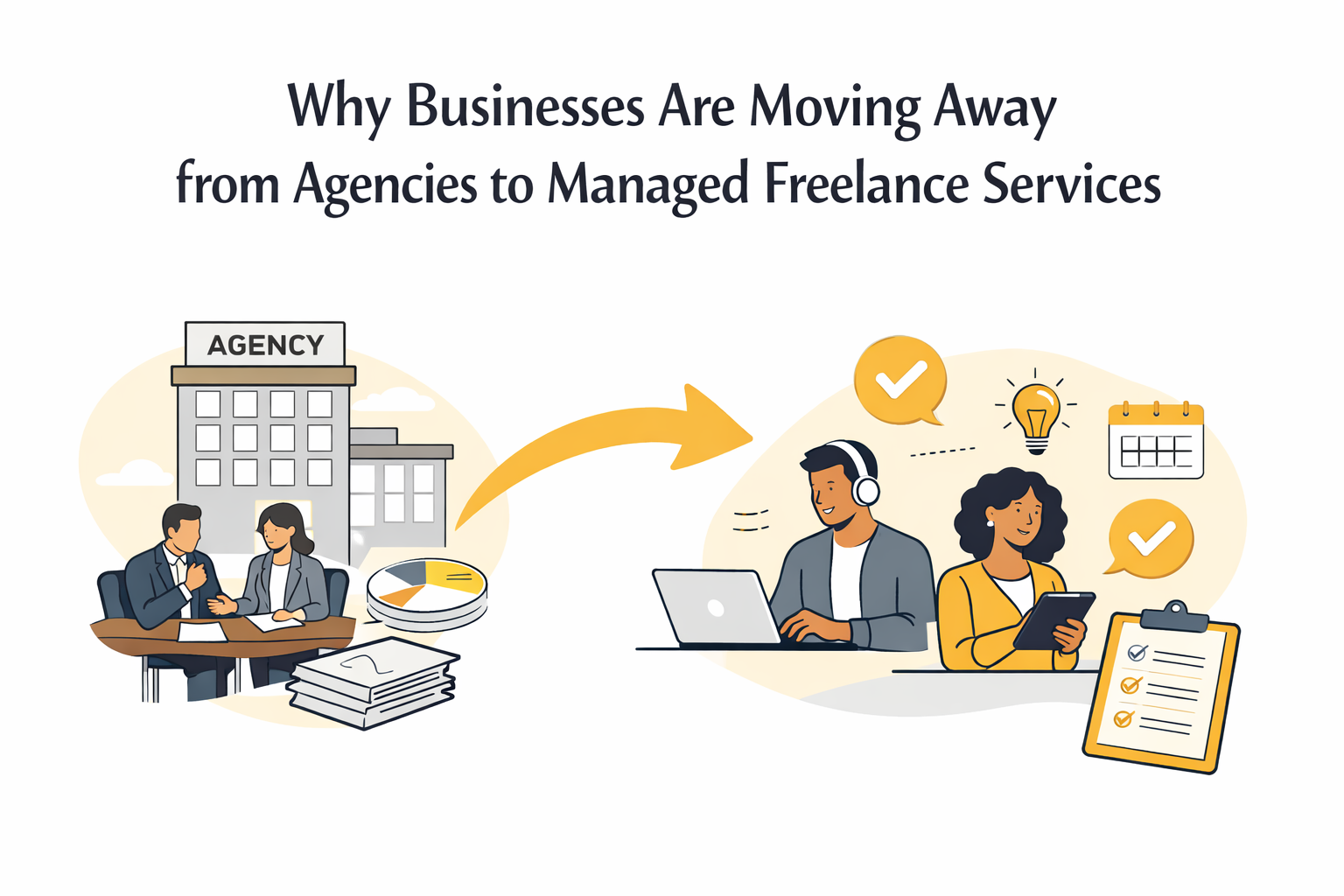
Why Businesses Are Moving Away from Agencies to Managed Freelance Services
For nearly two decades, agencies dominated the digital services landscape. They promised strategy, execution, and growth under one roof. Yet today, founders, growth leaders, and marketing heads are quietly – and strategically – changing course. Not because agencies no longer deliver value.But because the way businesses grow has fundamentally changed. Scaling today demands speed, specialization, flexibility, and measurable ROI.And increasingly, the traditional agency model struggles to deliver all four at once. This is why businesses across SaaS, e-commerce, and B2B services are moving away from agencies to managed freelance services – a delivery model designed for modern growth. Let’s unpack what’s driving this shift, what decision-makers are really evaluating, and how smart teams are restructuring their digital execution. The Modern Growth Problem Agencies Were Never Designed to Solve Growth leaders often ask a deceptively simple question: “Why does scaling become harder after month three?” The answer rarely lies in strategy.It lies in execution friction. Traditional agencies were built for: Modern businesses, however, now operate in: This mismatch creates three recurring problems. 1. Cost Inflation Without Output Transparency Agencies carry overhead – layers of management, account teams, office costs, bench resources. Founders usually discover too late that: The result?High monthly spend, unclear ROI, and limited control. Why Businesses Are Leaving Agencies: The Real Drivers Behind the Shift The move away from agencies is not emotional.It’s operational. Across industries, the same decision triggers keep appearing. 1. The Demand for Specialist Skill Over Generalist Delivery Growth today is no longer a “full-service” problem. SEO requires technical specialists.Paid media needs performance analysts.Product marketing needs positioning experts.Conversion optimization needs experimentation engineers. Agencies often staff generalists. Freelance specialists, on the other hand: This is why more businesses are moving from agencies to freelancers – but not unmanaged freelancers. They want specialization without chaos. 2. Agility Has Become a Strategic Advantage Growth leaders frequently ask: “Why does every agency change request take two weeks?” Because agency workflows are built around: In contrast, managed freelance services operate with: This agility allows businesses to: 3. ROI Pressure Is Forcing Procurement to Rethink the Model Today, marketing and growth budgets are under unprecedented scrutiny. Procurement and finance teams now evaluate: The question is no longer: “Which agency is best?” It’s now: “Agency vs freelancers – which is better for performance and cost predictability?” And increasingly, the data favors hybrid and managed freelance models. Agency vs Freelancers: A Strategic Comparison Factor Traditional Agencies Managed Freelance Services (WTF Model) Cost Structure Fixed retainers, high overhead Variable, execution-linked pricing Talent Quality Mixed seniority, rotating teams Curated senior specialists Agility Slow change cycles Rapid deployment and scaling Transparency Limited visibility into execution Direct access, outcome reporting Specialization Generalist teams Deep niche expertise Risk Long-term lock-in Modular, low-commitment model This is why freelancers vs agencies for businesses is no longer a tactical debate – it’s a strategic delivery decision. The Rise of Managed Freelance Services: A Smarter Hybrid Model Here’s the critical insight competitors often miss: Most businesses don’t want agencies.They also don’t want marketplaces. They want: This is where managed freelancers for businesses enters. At We The Freelancer (WTF), the model combines: In effect, businesses receive: Agency-level reliability with freelance-level specialization and flexibility. This hybrid delivery model is fast becoming the default for: Fractional Teams vs Agencies: Why Modular Delivery Wins Another reason brands are leaving agencies is organizational. Instead of outsourcing entire departments, growth leaders now build fractional teams: Compared to agencies: This hybrid delivery model for digital services enables: Where Agencies Still Make Sense – And Where They Don’t A fair evaluation matters. Agencies still perform well when: But they struggle when: In high-growth environments, managed freelance services consistently outperform. How WTF Delivers a Better Alternative to Agencies At We The Freelancer (WTF), we didn’t replace agencies.We redesigned delivery. Our managed freelance services model focuses on three principles. 1. Curated Specialist Teams, Not Open Marketplaces We don’t assign random freelancers.We build curated freelance teams aligned to: 2. Relationship Management + Quality Assurance Every engagement includes: This removes the two biggest risks in outsourcing:execution inconsistency and accountability gaps. 3. Modular Services Aligned to Growth Our service pillars integrate directly into this delivery model: Strategic Decision Framework: Should You Move Away From Agencies? Growth leaders usually face one of these scenarios: Scenario 1: Performance Has Plateaued You need faster testing, deeper specialization, and lower CAC. ➡ Managed freelance services outperform agencies. Scenario 2: Budgets Are Under Scrutiny You need transparency, flexibility, and ROI alignment. ➡ Freelance management services reduce cost without sacrificing quality. Scenario 3: You’re Scaling Globally You need distributed talent and time-zone execution. ➡ Hybrid delivery models scale better than centralized agencies. Learning From Your Past Outsourcing Decisions If you’re evaluating this shift, two prior WTF insights may help: Together, they explain: Frequently Asked Questions The Future of Digital Delivery Is Modular, Specialist, and Managed The agency model is not disappearing.But it is no longer the default. The future belongs to: For growth leaders, the question is no longer: “Which agency should we hire?” It’s now: “Which delivery model gives us the most control, scalability, and ROI?” Ready to Explore a Smarter Delivery Model? If you’re evaluating alternatives to agencies – or redesigning your growth execution model – a short strategic conversation can clarify your next move. Book a 30-minute consultation with WTF We’ll map: And help you decide whether managed freelance services are the right next step.
Outsourced Digital Services vs Hiring In-House: What’s Better for Businesses?
The Real Question Isn’t Cost — It’s Control, Speed, and Outcomes Every growth-stage business eventually hits the same wall. Marketing velocity slows. Product releases slip. Campaign performance plateaus. And suddenly, the question lands on the leadership table: Should we build an in-house team, or outsource digital services? On the surface, this looks like a budget decision. In reality, it’s a strategic operating choice that shapes your speed to market, execution quality, scalability, and long-term growth efficiency. Founders often struggle with this tradeoff. Growth leaders usually ask: In this guide, we break down the in-house vs outsourcing decision with a practical, executive-friendly framework — grounded in real delivery models used by SaaS companies, digital-first enterprises, and high-growth teams. In-House vs Outsourcing: A Quick Definition Before comparing models, let’s clarify what each approach really means in modern digital delivery. What “Hiring In-House” Typically Involves What “Outsourced Digital Services” Usually Means In practice, today’s outsourcing spans three models: Each behaves very differently — and this distinction matters. High-Level Comparison: In-House vs Outsourced Digital Services Factor In-House Team Outsourced Digital Services Cost Structure High fixed cost Variable, usage-based Hiring Speed Slow (4–12 weeks) Fast (days to 2 weeks) Skill Breadth Limited to team size Wide, on-demand expertise Scalability Rigid Highly flexible Control High Medium–High (depends on model) Management Overhead High Low to moderate Risk Hiring mistakes, attrition Vendor dependency, quality variance This table explains what changes.Now let’s explore when each model actually works best. When Should You Hire In-House? Hiring in-house makes strategic sense when: 1. The Function Is Core to Your IP or Competitive Advantage If digital execution is your product or your moat — product engineering, proprietary data science, or platform development — internal ownership matters. 2. Workload Is Predictable and Long-Term In-house teams perform best when: 3. You Need Deep Institutional Knowledge Some functions benefit from context that only internal teams accumulate over time: 4. You Can Afford the Full Operating Cost True in-house cost is rarely just salary. It includes: Hidden reality:In many mid-stage companies, 30–40% of in-house cost is operational overhead, not delivery. When Does Outsourcing Make More Strategic Sense? Outsourcing outperforms in-house hiring when: 1. You Need Speed and Flexibility Launching campaigns, scaling performance marketing, or building growth infrastructure often requires: Outsourcing compresses hiring cycles from months to weeks. 2. Skills Are Specialized or Short-Term SEO specialists, CRO experts, performance marketers, data engineers — these profiles are: 3. You’re Scaling Faster Than Your Hiring Pipeline Startups and growth-stage firms often face: Outsourcing absorbs volatility without increasing long-term fixed cost. 4. You Want Output Accountability, Not Headcount Ownership Modern managed services focus on: This shifts leadership focus from managing people to managing outcomes. Cost Breakdown: Is Outsourcing Really Cheaper Than Hiring In-House? This is where many decisions go wrong. True Cost of In-House (Per Mid-Level Digital Role) Typical annual cost: 1.4x – 1.7x base salary A $60,000 role often costs $85,000–$100,000+ annually. True Cost of Outsourced Digital Services Depends heavily on the model: Model Cost Efficiency Risk Agencies High cost, bundled Low control Marketplaces Low cost High quality risk Managed services Optimized Low operational risk In managed freelance services, like We The Freelancer’s model: Result:Lower effective cost per output, not just per hour. Quality, Control & Reliability: The Real Differentiator This is where the decision usually gets emotional. In-House Advantages Outsourcing Risks (Traditional Models) Where Managed Services Change the Equation High-performance outsourcing today looks very different: At We The Freelancer (WTF), for example: This hybrid model preserves: While keeping: Decision Framework: In-House or Outsource? Use this executive-level decision filter. Choose In-House If: Choose Outsourcing If: Choose a Hybrid / Managed Model If: This is where outsourcing vs hiring in house becomes less binary — and more architectural. Real-World Scenarios SaaS Growth Team Needs SEO, performance marketing, analytics, CRO. Hiring 4 specialists in-house = slow, expensive, high risk.Managed outsourcing = immediate skill coverage, scalable delivery. E-commerce Brand Campaign peaks during sales cycles. In-house teams underutilized in off-season.Outsourcing absorbs demand volatility without layoffs or burnout. B2B Services Firm Needs predictable lead flow, content, automation. Hybrid model works best:Core strategy in-house, execution outsourced with delivery governance. FAQs: In-House vs Outsourcing How We The Freelancer Fits Into This Decision Most companies don’t fail because they chose in-house or outsourcing. They fail because they chose: We The Freelancer (WTF) operates as a managed freelance services partner — combining: This positions WTF as: Conclusion: In-House vs Outsourcing — Which Is Better? So, in house vs outsourcing — which is better? The honest answer: For modern growth teams, the most resilient model is not choosing one — but designing the right blend. If your goal is: Then outsourced digital services with managed governance increasingly outperform traditional hiring. Ready to Make the Right Delivery Decision? If you’re currently weighing in-house hiring vs outsourced digital services, the right answer depends on your growth stage, operating model, and performance goals — not generic benchmarks. At We The Freelancer (WTF), we help founders, marketing leaders, and product teams design scalable delivery models using managed freelance services, dedicated specialists, and outcome-driven execution — without agency overhead or hiring risk. If you’d like an expert perspective on: Book a strategic consultation with our team.We’ll review your current setup, growth objectives, and execution gaps — and recommend a delivery model built for predictable, sustainable growth. No pitches. No templates. Just practical guidance from people who build and scale digital teams every day.

What Are Managed Professional Services? A Smarter Alternative to Traditional Agencies
Running a growing business today means balancing speed, quality, and cost-often with limited internal resources. Hiring full-time specialists is expensive, while traditional agencies come with rigid contracts, rotating teams, and unpredictable pricing. Managed professional services provide businesses with ongoing access to vetted experts, predictable costs, and managed execution-without agencies or freelance marketplaces. This is where managed professional services become a smarter alternative. At We The Freelancer (WTF), we help businesses access professional freelance services and outsourced digital services through a fully managed model-so you get results without managing freelancers or paying agency overhead. Understanding Managed Professional Services (MPS) Managed professional services (MPS) are an ongoing service model where a provider takes full ownership of execution, quality control, and delivery for specific business functions. Unlike traditional outsourcing or one-off freelance work, MPS focuses on: With managed professional services, businesses gain a reliable extension of their internal team-without the risks of hiring or agency dependency. Learn more about our managed professional services. In Simple Terms Managed professional services allow businesses to outsource critical work to vetted experts while maintaining full control, predictable costs, and consistent quality—without hiring in-house teams or relying on traditional agencies. How Managed Professional Services Go Beyond Traditional Outsourcing Basic outsourcing often means hiring external help for isolated tasks, then managing everything yourself. Managed professional services go further. With MPS, you receive: At WTF, our freelancer management services remove the burden of coordination, communication, and performance tracking-so businesses can focus on growth instead of operations. Core Components of a Managed Professional Services Model A strong managed professional services partnership includes: Dedicated Specialists You work with assigned experts who understand your business, tools, and objectives-no rotating agency staff. Defined Scope of Work Clear responsibilities, deliverables, and timelines ensure transparency and accountability. Service-Level Agreements (SLAs) Performance benchmarks such as turnaround times, quality standards, and reporting cadence. Predictable Pricing Fixed monthly pricing eliminates surprise invoices and simplifies budgeting. Outcome Ownership Success is measured by results-not billable hours. This structure ensures consistent delivery and freelancer quality assurance across every engagement. Managed Professional Services vs. Traditional Agencies While agencies are useful for short-term campaigns, they often struggle with long-term execution and accountability. Managed Professional Services vs. Traditional Agencies While agencies are useful for short-term campaigns, they often struggle with long-term execution and accountability. Managed Professional Services vs Agencies vs Freelancers Feature Managed Professional Services Traditional Agencies Freelancers Pricing Model Fixed & predictable Variable / hourly Hourly or per task Team Structure Dedicated specialists Rotating teams Individual Management Required None Medium High Quality Assurance Built-in Limited None Scalability High Medium Low Accountability SLA-based Project-based Individual Best For Ongoing execution & growth Short campaigns One-off tasks For businesses seeking outsourced business solutions that evolve over time, managed professional services offer greater stability and long-term value. Why Dedicated Teams Matter More Than Rotating Staff One of the biggest advantages of managed professional services is continuity. Dedicated teams: At WTF, every client is supported by vetted specialists and a Dedicated Relationship Manager-ensuring seamless execution and consistent results. Strategic Benefits of Managed Professional Services Predictable Costs and Budget Control Managed professional services convert fluctuating agency costs into stable, forecastable expenses-making financial planning easier. Focus on Core Business Priorities By outsourcing execution, internal teams can focus on leadership, sales, and innovation instead of operational bottlenecks. Built-In Quality and Performance Standards SLAs, reporting, and ongoing reviews ensure continuous improvement and accountability. When Managed Professional Services Are the Right Choice Managed professional services are ideal when: This makes MPS especially effective for marketing execution, content production, SEO operations, and digital growth initiatives. Businesses looking to scale with business growth experts often choose a managed model over agencies. Scalability Without Agency Constraints Managed professional services scale with your business. Need more support during peak demand? Scale up.Need to adjust scope? Scale down. Unlike rigid agency retainers, MPS adapts quickly-making it ideal for startups, SMBs, and fast-growing companies. Choosing the Right Managed Professional Services Partner Not all providers offer true managed services. When evaluating a partner, look for: At We The Freelancer (WTF), businesses gain access to vetted specialists, structured management, and reliable execution-without agency bureaucracy. Many brands rely on professional freelance services for content marketing delivered through our managed model. Final Thoughts: Why Managed Professional Services Are the Future Managed professional services combine the flexibility of freelancers with the structure and accountability businesses need to scale. They offer: For businesses looking to grow without agency overhead or hiring risks, managed professional services provide a future-ready solution. Frequently Asked Questions About Managed Professional Services