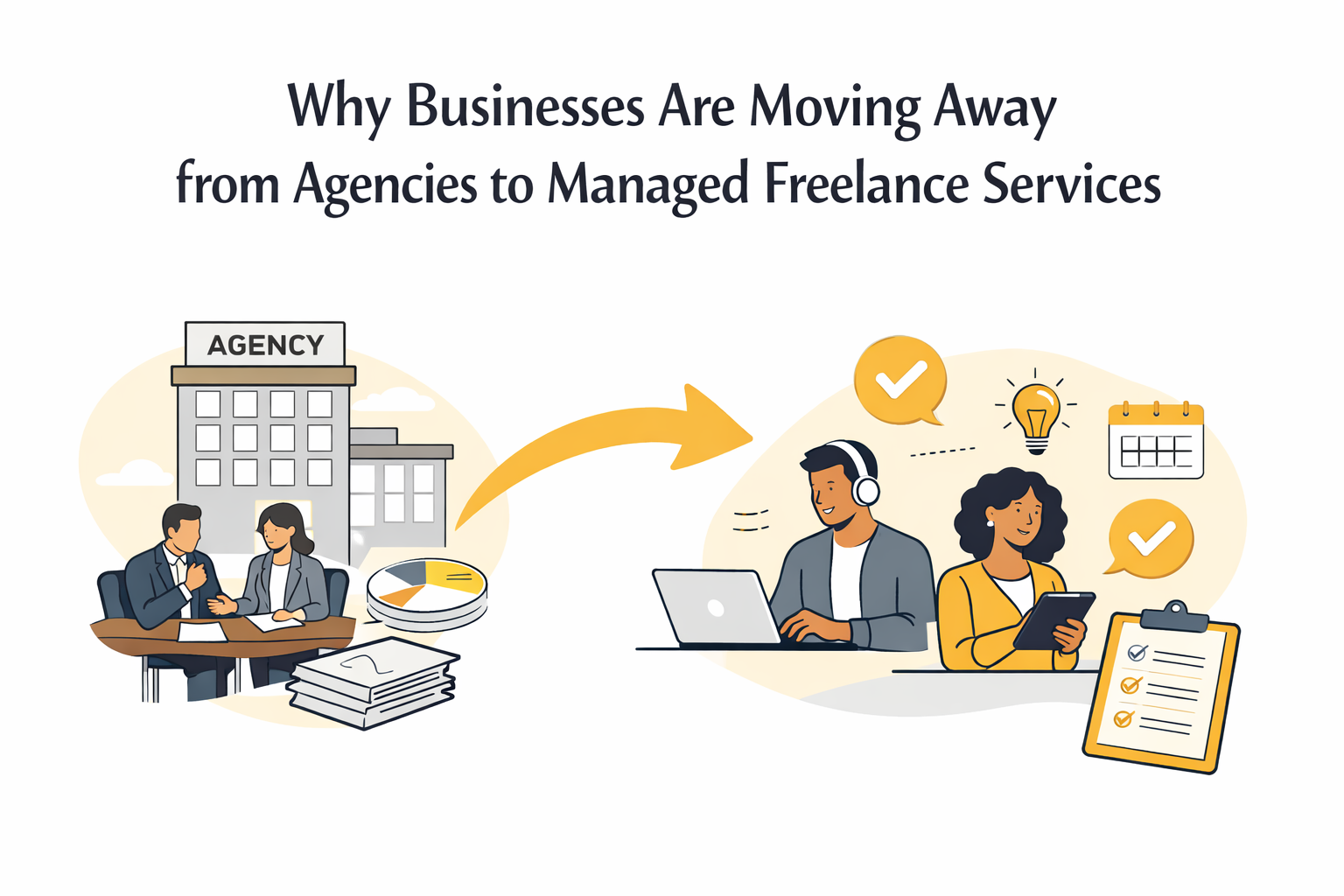
For nearly two decades, agencies dominated the digital services landscape. They promised strategy, execution, and growth under one roof.
Yet today, founders, growth leaders, and marketing heads are quietly – and strategically – changing course.
Not because agencies no longer deliver value.
But because the way businesses grow has fundamentally changed.
Scaling today demands speed, specialization, flexibility, and measurable ROI.
And increasingly, the traditional agency model struggles to deliver all four at once.
This is why businesses across SaaS, e-commerce, and B2B services are moving away from agencies to managed freelance services – a delivery model designed for modern growth.
Let’s unpack what’s driving this shift, what decision-makers are really evaluating, and how smart teams are restructuring their digital execution.
The Modern Growth Problem Agencies Were Never Designed to Solve
Growth leaders often ask a deceptively simple question:
“Why does scaling become harder after month three?”
The answer rarely lies in strategy.
It lies in execution friction.
Traditional agencies were built for:
- Long retainers
- Fixed team structures
- Centralized processes
- Annual planning cycles
Modern businesses, however, now operate in:
- Rapid experimentation cycles
- Multi-channel performance environments
- Short product iterations
- Constant talent specialization
This mismatch creates three recurring problems.
1. Cost Inflation Without Output Transparency
Agencies carry overhead – layers of management, account teams, office costs, bench resources.
Founders usually discover too late that:
- Only 40–60% of their retainer funds actual execution
- Senior talent is often replaced by junior delivery teams
- Performance accountability is diluted across departments
The result?
High monthly spend, unclear ROI, and limited control.
Why Businesses Are Leaving Agencies: The Real Drivers Behind the Shift
The move away from agencies is not emotional.
It’s operational.
Across industries, the same decision triggers keep appearing.
1. The Demand for Specialist Skill Over Generalist Delivery
Growth today is no longer a “full-service” problem.
SEO requires technical specialists.
Paid media needs performance analysts.
Product marketing needs positioning experts.
Conversion optimization needs experimentation engineers.
Agencies often staff generalists.
Freelance specialists, on the other hand:
- Focus on one discipline deeply
- Stay current with platforms and tools
- Deliver faster execution cycles
This is why more businesses are moving from agencies to freelancers – but not unmanaged freelancers.
They want specialization without chaos.
2. Agility Has Become a Strategic Advantage
Growth leaders frequently ask:
“Why does every agency change request take two weeks?”
Because agency workflows are built around:
- Internal approvals
- Resource planning
- Utilization models
- Hierarchical delivery chains
In contrast, managed freelance services operate with:
- Direct execution paths
- Modular teams
- Fast onboarding
- Flexible scaling
This agility allows businesses to:
- Launch campaigns faster
- Experiment without renegotiating retainers
- Scale up or down without contractual friction
3. ROI Pressure Is Forcing Procurement to Rethink the Model
Today, marketing and growth budgets are under unprecedented scrutiny.
Procurement and finance teams now evaluate:
- Cost per outcome
- Talent utilization efficiency
- Flexibility risk
- Long-term scalability
The question is no longer:
“Which agency is best?”
It’s now:
“Agency vs freelancers – which is better for performance and cost predictability?”
And increasingly, the data favors hybrid and managed freelance models.
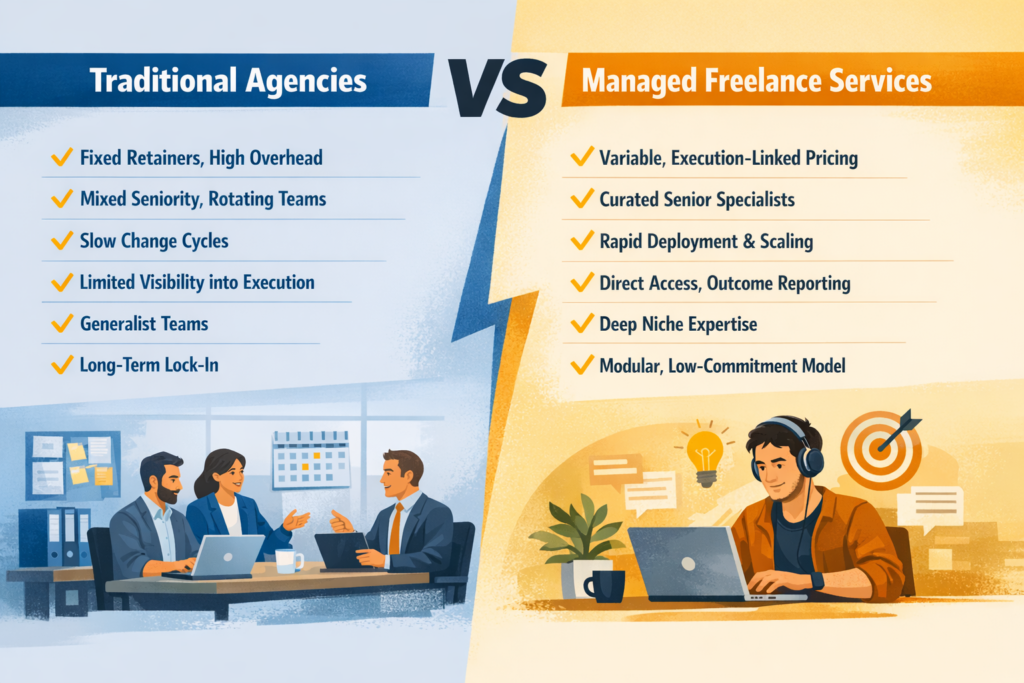
Agency vs Freelancers: A Strategic Comparison
| Factor | Traditional Agencies | Managed Freelance Services (WTF Model) |
| Cost Structure | Fixed retainers, high overhead | Variable, execution-linked pricing |
| Talent Quality | Mixed seniority, rotating teams | Curated senior specialists |
| Agility | Slow change cycles | Rapid deployment and scaling |
| Transparency | Limited visibility into execution | Direct access, outcome reporting |
| Specialization | Generalist teams | Deep niche expertise |
| Risk | Long-term lock-in | Modular, low-commitment model |
This is why freelancers vs agencies for businesses is no longer a tactical debate – it’s a strategic delivery decision.
The Rise of Managed Freelance Services: A Smarter Hybrid Model
Here’s the critical insight competitors often miss:
Most businesses don’t want agencies.
They also don’t want marketplaces.
They want:
- Specialist talent
- Reliable delivery
- Central accountability
- Predictable outcomes
This is where managed freelancers for businesses enters.
At We The Freelancer (WTF), the model combines:
- Curated freelance specialists
- A dedicated relationship manager
- Quality assurance layers
- Outcome-driven delivery frameworks
In effect, businesses receive:
Agency-level reliability with freelance-level specialization and flexibility.
This hybrid delivery model is fast becoming the default for:
- Scaling SaaS teams
- Performance-driven e-commerce brands
- Global B2B growth teams
Fractional Teams vs Agencies: Why Modular Delivery Wins
Another reason brands are leaving agencies is organizational.
Instead of outsourcing entire departments, growth leaders now build fractional teams:
- Fractional SEO lead
- Fractional performance marketer
- Fractional product growth strategist
- On-demand designers and developers
Compared to agencies:
- Teams are built around outcomes, not services
- Talent matches the exact growth stage
- Budget follows performance, not contracts
This hybrid delivery model for digital services enables:
- Faster experimentation
- Better cross-channel coordination
- Lower long-term dependency risk
Where Agencies Still Make Sense – And Where They Don’t
A fair evaluation matters.
Agencies still perform well when:
- Brand building is the primary goal
- Creative ideation outweighs execution velocity
- Long-term strategic planning dominates
But they struggle when:
- Performance marketing drives growth
- Multi-channel experimentation is required
- Budgets fluctuate
- Specialists matter more than scale
In high-growth environments, managed freelance services consistently outperform.
How WTF Delivers a Better Alternative to Agencies
At We The Freelancer (WTF), we didn’t replace agencies.
We redesigned delivery.
Our managed freelance services model focuses on three principles.
1. Curated Specialist Teams, Not Open Marketplaces
We don’t assign random freelancers.
We build curated freelance teams aligned to:
- Industry
- Growth stage
- Channel mix
- Performance objectives
2. Relationship Management + Quality Assurance
Every engagement includes:
- A dedicated relationship manager
- Structured delivery governance
- Performance reviews
- Quality assurance before deployment
This removes the two biggest risks in outsourcing:
execution inconsistency and accountability gaps.
3. Modular Services Aligned to Growth
Our service pillars integrate directly into this delivery model:
- Design & Development Services – scalable product, web, and UX execution
- Content Marketing Services – SEO-driven and conversion-focused content systems
- Performance Marketing Services – ROI-centric paid acquisition and CRO
- Growth Marketing Services – experimentation frameworks and scalable pipelines
Strategic Decision Framework: Should You Move Away From Agencies?
Growth leaders usually face one of these scenarios:
Scenario 1: Performance Has Plateaued
You need faster testing, deeper specialization, and lower CAC.
➡ Managed freelance services outperform agencies.
Scenario 2: Budgets Are Under Scrutiny
You need transparency, flexibility, and ROI alignment.
➡ Freelance management services reduce cost without sacrificing quality.
Scenario 3: You’re Scaling Globally
You need distributed talent and time-zone execution.
➡ Hybrid delivery models scale better than centralized agencies.
Learning From Your Past Outsourcing Decisions
If you’re evaluating this shift, two prior WTF insights may help:
- What Are Managed Professional Services? A Smarter Alternative to Traditional Agencies
- Outsourced Digital Services vs Hiring In-House: What’s Better for Businesses
Together, they explain:
- Why agency models struggle
- Where in-house teams fail to scale
- How managed delivery bridges both gaps
Frequently Asked Questions
Because agencies often lack agility, transparency, and specialist depth while carrying high overhead costs. Businesses now prefer flexible, performance-aligned delivery models.
Individually, freelancers offer specialization and cost efficiency. Managed freelance services combine these benefits with governance, reliability, and accountability – outperforming both agencies and marketplaces.
A delivery model where curated freelance teams are managed by a central partner providing relationship management, quality assurance, and performance oversight.
Unmanaged freelancing is risky. Managed freelance services reduce risk by controlling quality, continuity, and accountability.
The Future of Digital Delivery Is Modular, Specialist, and Managed
The agency model is not disappearing.
But it is no longer the default.
The future belongs to:
- Modular teams
- Specialist execution
- Outcome-driven delivery
- Managed talent ecosystems
For growth leaders, the question is no longer:
“Which agency should we hire?”
It’s now:
“Which delivery model gives us the most control, scalability, and ROI?”
Ready to Explore a Smarter Delivery Model?
If you’re evaluating alternatives to agencies – or redesigning your growth execution model – a short strategic conversation can clarify your next move.
Book a 30-minute consultation with WTF
We’ll map:
- Your growth stage
- Talent gaps
- Cost structure
- Delivery model
And help you decide whether managed freelance services are the right next step.