
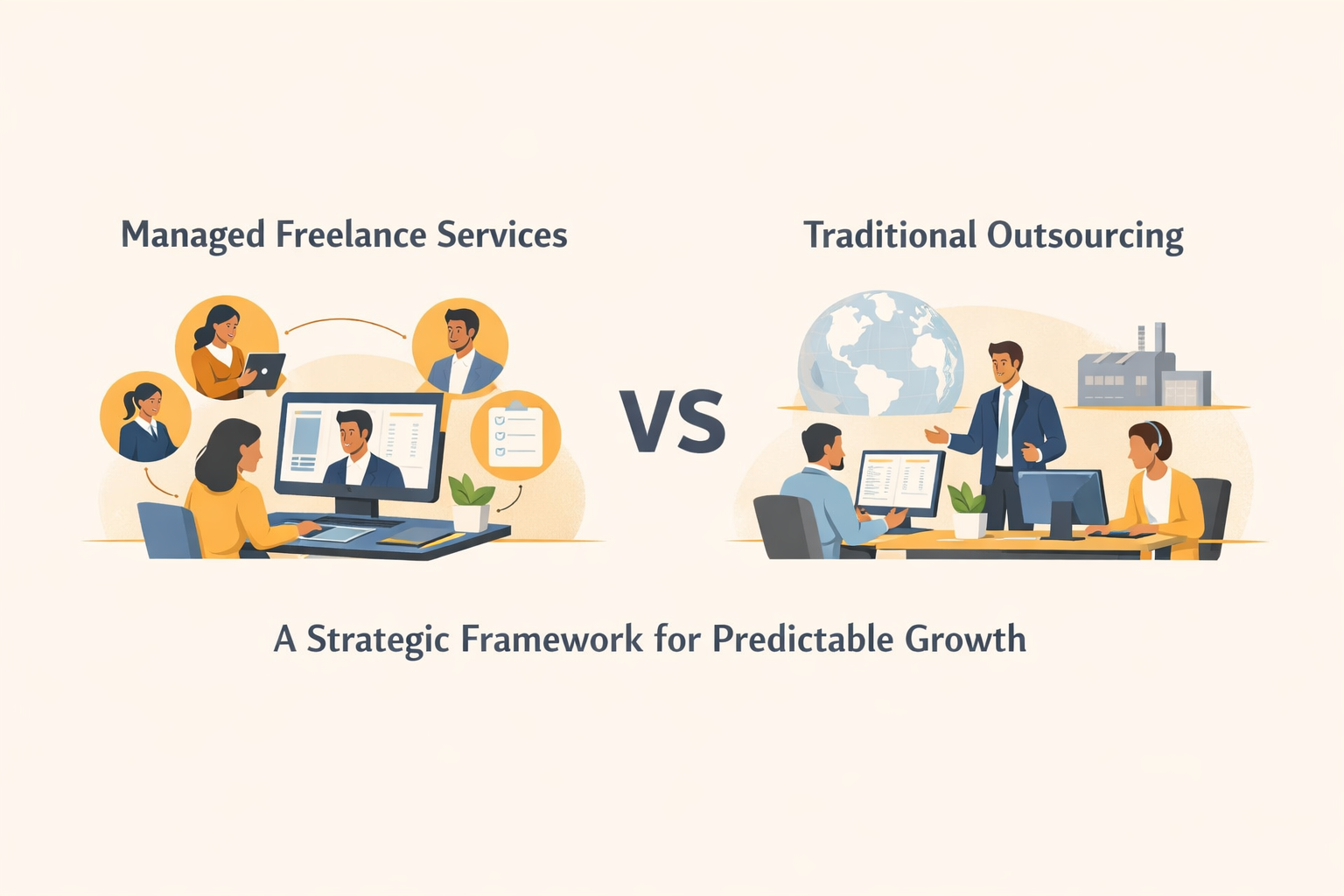
Founders often scale fast and then hit the same wall. Freelancers become inconsistent. Agencies become expensive. Internal teams become overloaded.Growth slows not because strategy failed… but because delivery became unpredictable. So the real executive question isn’t “Should we outsource?”It’s “What operating model gives us control, scalability, and reliable execution?” That’s where managed freelance services enter the conversation. This guide breaks down how the model works, when it outperforms agencies and marketplaces, and how B2B growth teams use it to stabilize execution without inflating overhead. What Are Managed Freelance Services? Managed freelance services combine the flexibility of independent specialists with the structure, accountability, and quality control of a professional service partner. Instead of hiring freelancers individually or outsourcing to a large agency, businesses engage a managed provider that: In practice, this creates a delivery layer between strategy and execution something most scaling companies lack. A structured provider like We The Freelancer (WTF) operates as an embedded growth partner, not a marketplace or staffing vendor. Why Do Most Growth Strategies Fail After Month Three? Growth leaders usually ask this after launching campaigns, content initiatives, or performance programs that start strong then plateau. The pattern is predictable: Stage What Happens Root Cause Month 1 Strategy and launch energy Leadership attention is high Month 2 Execution begins to fragment Multiple vendors, unclear ownership Month 3 Performance stagnates No operational accountability Month 4+ Cost rises, ROI unclear Delivery model is reactive The issue isn’t capability it’s operational structure. Managed freelance services solve this by introducing: Managed Freelance Services vs Agencies vs Marketplaces Executives evaluating delivery partners typically compare three models. The strategic differences are operational, not cosmetic. Comparison Framework Factor Managed Freelance Services Traditional Agency Freelance Marketplace Execution Model Managed specialists with oversight Centralized internal team Self-managed contractors Cost Structure Predictable, scalable High retainers Variable, unpredictable Quality Assurance Built-in governance Agency-dependent Client responsibility Scalability Modular, flexible Resource-constrained Coordination-heavy Accountability Dedicated relationship manager Account manager None Speed of Deployment High Medium Variable Risk Exposure Low Medium High Strategic Alignment Continuous optimization Campaign-based Task-based Key insight:Marketplaces optimize for talent access.Agencies optimize for service packaging.Managed freelance services optimize for delivery outcomes. That distinction changes ROI trajectories over time. When Should Businesses Choose Managed Freelance Services? Not every organization needs this model. But high-growth and performance-driven teams consistently benefit in specific scenarios. Ideal Use Cases 1. Scaling Without Hiring 2. Replacing Fragmented Vendor Ecosystems 3. Seeking Predictable Growth Infrastructure 4. Needing Specialized Expertise On-Demand Growth leaders typically choose this model when they want:✔ Control without hiring✔ Expertise without agency overhead✔ Scalability without operational chaos How the Managed Freelance Delivery Framework Works A mature managed model operates through a structured lifecycle not ad-hoc outsourcing. Step 1: Growth Objective Alignment Business goals translate into measurable execution roadmaps. Example: Step 2: Specialist Matching and Team Structuring Instead of hiring one generalist, the provider assembles a modular team: Step 3: Relationship Management Layer This is the differentiator most companies underestimate. The relationship manager: Step 4: Continuous Optimization Cycle Execution becomes a loop:Plan → Execute → Measure → Improve This shifts outsourcing from reactive to proactive the same advantage that made managed IT dominant in enterprise operations. Strategic Advantages for B2B Growth Leaders 1. Operational Control Without Employment Risk Scaling teams often struggle between hiring and outsourcing. Managed freelance services provide a third path controlled external execution. 2. Predictable Cost Structure Unlike agencies that bundle services or freelancers who bill unpredictably, managed models align cost with output and scope. 3. Reliability at Scale Consistency is the hidden growth multiplier. Governance frameworks ensure: 4. Faster Strategic Iteration Because specialists are modular, teams can pivot faster: Real-World Business Scenario Scenario: B2B SaaS Expansion Challenge:A SaaS company wants to grow inbound pipeline globally but cannot justify hiring a full internal growth team. Traditional Options: Managed Freelance Model Outcome: Business impact:✔ Lower operational friction✔ Continuous execution✔ Improved marketing ROI visibility FAQ: Managed Freelance Services for B2B Companies The Strategic Takeaway The outsourcing conversation is evolving. Businesses no longer choose between:Hiring internallyOROutsourcing externally They choose how execution is governed. Managed freelance services represent a structural shift from vendor management to delivery partnership. For growth-focused organizations, the real value isn’t cheaper execution.It’s predictable, scalable, accountable growth infrastructure. And in competitive B2B markets, operational reliability becomes a strategic advantage. Book a strategic consultation with our team.We’ll review your current setup, growth objectives, and execution gaps — and recommend a delivery model built for predictable, sustainable growth.