
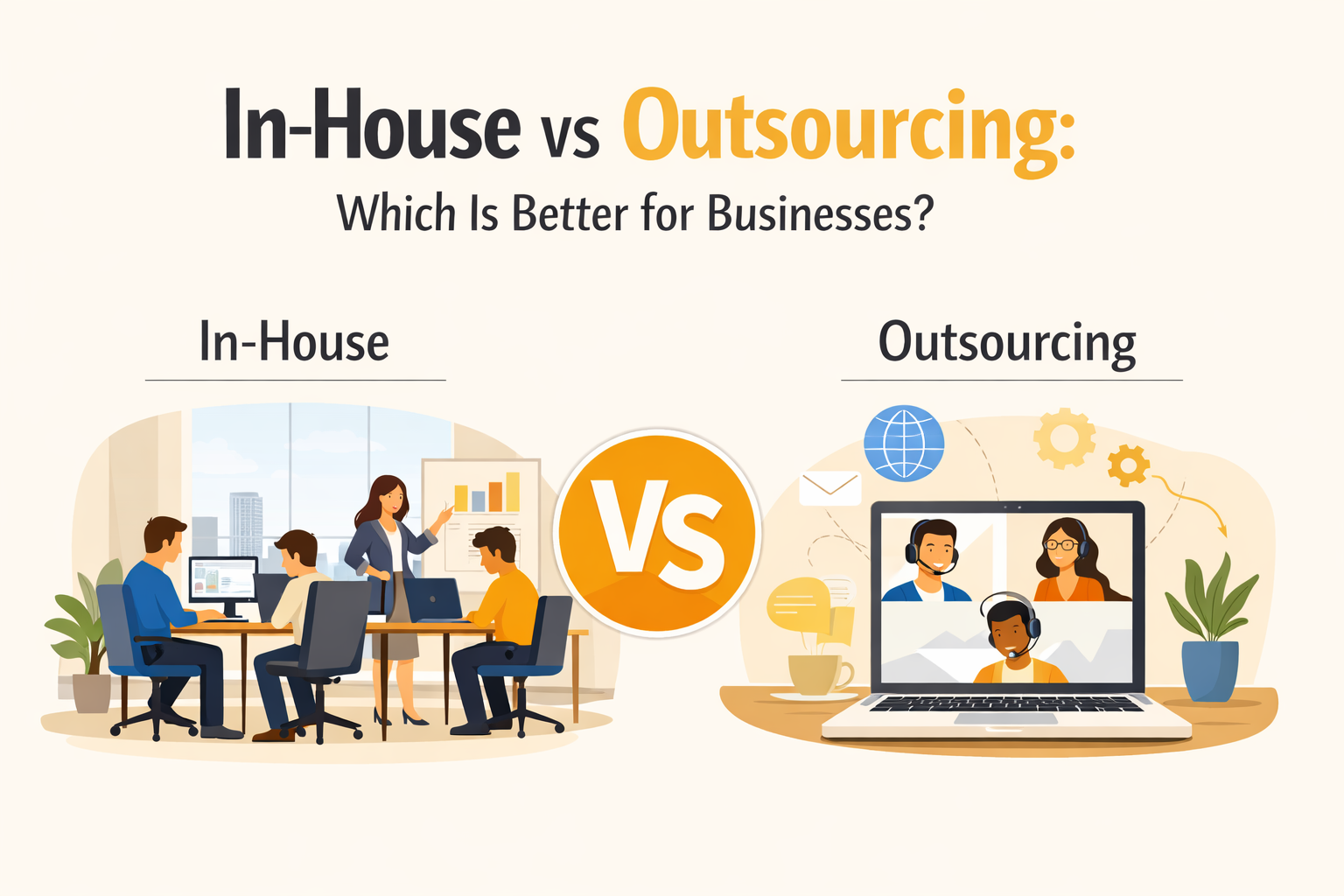
The Real Question Isn’t Cost — It’s Control, Speed, and Outcomes Every growth-stage business eventually hits the same wall. Marketing velocity slows. Product releases slip. Campaign performance plateaus. And suddenly, the question lands on the leadership table: Should we build an in-house team, or outsource digital services? On the surface, this looks like a budget decision. In reality, it’s a strategic operating choice that shapes your speed to market, execution quality, scalability, and long-term growth efficiency. Founders often struggle with this tradeoff. Growth leaders usually ask: In this guide, we break down the in-house vs outsourcing decision with a practical, executive-friendly framework — grounded in real delivery models used by SaaS companies, digital-first enterprises, and high-growth teams. In-House vs Outsourcing: A Quick Definition Before comparing models, let’s clarify what each approach really means in modern digital delivery. What “Hiring In-House” Typically Involves What “Outsourced Digital Services” Usually Means In practice, today’s outsourcing spans three models: Each behaves very differently — and this distinction matters. High-Level Comparison: In-House vs Outsourced Digital Services Factor In-House Team Outsourced Digital Services Cost Structure High fixed cost Variable, usage-based Hiring Speed Slow (4–12 weeks) Fast (days to 2 weeks) Skill Breadth Limited to team size Wide, on-demand expertise Scalability Rigid Highly flexible Control High Medium–High (depends on model) Management Overhead High Low to moderate Risk Hiring mistakes, attrition Vendor dependency, quality variance This table explains what changes.Now let’s explore when each model actually works best. When Should You Hire In-House? Hiring in-house makes strategic sense when: 1. The Function Is Core to Your IP or Competitive Advantage If digital execution is your product or your moat — product engineering, proprietary data science, or platform development — internal ownership matters. 2. Workload Is Predictable and Long-Term In-house teams perform best when: 3. You Need Deep Institutional Knowledge Some functions benefit from context that only internal teams accumulate over time: 4. You Can Afford the Full Operating Cost True in-house cost is rarely just salary. It includes: Hidden reality:In many mid-stage companies, 30–40% of in-house cost is operational overhead, not delivery. When Does Outsourcing Make More Strategic Sense? Outsourcing outperforms in-house hiring when: 1. You Need Speed and Flexibility Launching campaigns, scaling performance marketing, or building growth infrastructure often requires: Outsourcing compresses hiring cycles from months to weeks. 2. Skills Are Specialized or Short-Term SEO specialists, CRO experts, performance marketers, data engineers — these profiles are: 3. You’re Scaling Faster Than Your Hiring Pipeline Startups and growth-stage firms often face: Outsourcing absorbs volatility without increasing long-term fixed cost. 4. You Want Output Accountability, Not Headcount Ownership Modern managed services focus on: This shifts leadership focus from managing people to managing outcomes. Cost Breakdown: Is Outsourcing Really Cheaper Than Hiring In-House? This is where many decisions go wrong. True Cost of In-House (Per Mid-Level Digital Role) Typical annual cost: 1.4x – 1.7x base salary A $60,000 role often costs $85,000–$100,000+ annually. True Cost of Outsourced Digital Services Depends heavily on the model: Model Cost Efficiency Risk Agencies High cost, bundled Low control Marketplaces Low cost High quality risk Managed services Optimized Low operational risk In managed freelance services, like We The Freelancer’s model: Result:Lower effective cost per output, not just per hour. Quality, Control & Reliability: The Real Differentiator This is where the decision usually gets emotional. In-House Advantages Outsourcing Risks (Traditional Models) Where Managed Services Change the Equation High-performance outsourcing today looks very different: At We The Freelancer (WTF), for example: This hybrid model preserves: While keeping: Decision Framework: In-House or Outsource? Use this executive-level decision filter. Choose In-House If: Choose Outsourcing If: Choose a Hybrid / Managed Model If: This is where outsourcing vs hiring in house becomes less binary — and more architectural. Real-World Scenarios SaaS Growth Team Needs SEO, performance marketing, analytics, CRO. Hiring 4 specialists in-house = slow, expensive, high risk.Managed outsourcing = immediate skill coverage, scalable delivery. E-commerce Brand Campaign peaks during sales cycles. In-house teams underutilized in off-season.Outsourcing absorbs demand volatility without layoffs or burnout. B2B Services Firm Needs predictable lead flow, content, automation. Hybrid model works best:Core strategy in-house, execution outsourced with delivery governance. FAQs: In-House vs Outsourcing How We The Freelancer Fits Into This Decision Most companies don’t fail because they chose in-house or outsourcing. They fail because they chose: We The Freelancer (WTF) operates as a managed freelance services partner — combining: This positions WTF as: Conclusion: In-House vs Outsourcing — Which Is Better? So, in house vs outsourcing — which is better? The honest answer: For modern growth teams, the most resilient model is not choosing one — but designing the right blend. If your goal is: Then outsourced digital services with managed governance increasingly outperform traditional hiring. Ready to Make the Right Delivery Decision? If you’re currently weighing in-house hiring vs outsourced digital services, the right answer depends on your growth stage, operating model, and performance goals — not generic benchmarks. At We The Freelancer (WTF), we help founders, marketing leaders, and product teams design scalable delivery models using managed freelance services, dedicated specialists, and outcome-driven execution — without agency overhead or hiring risk. If you’d like an expert perspective on: Book a strategic consultation with our team.We’ll review your current setup, growth objectives, and execution gaps — and recommend a delivery model built for predictable, sustainable growth. No pitches. No templates. Just practical guidance from people who build and scale digital teams every day.